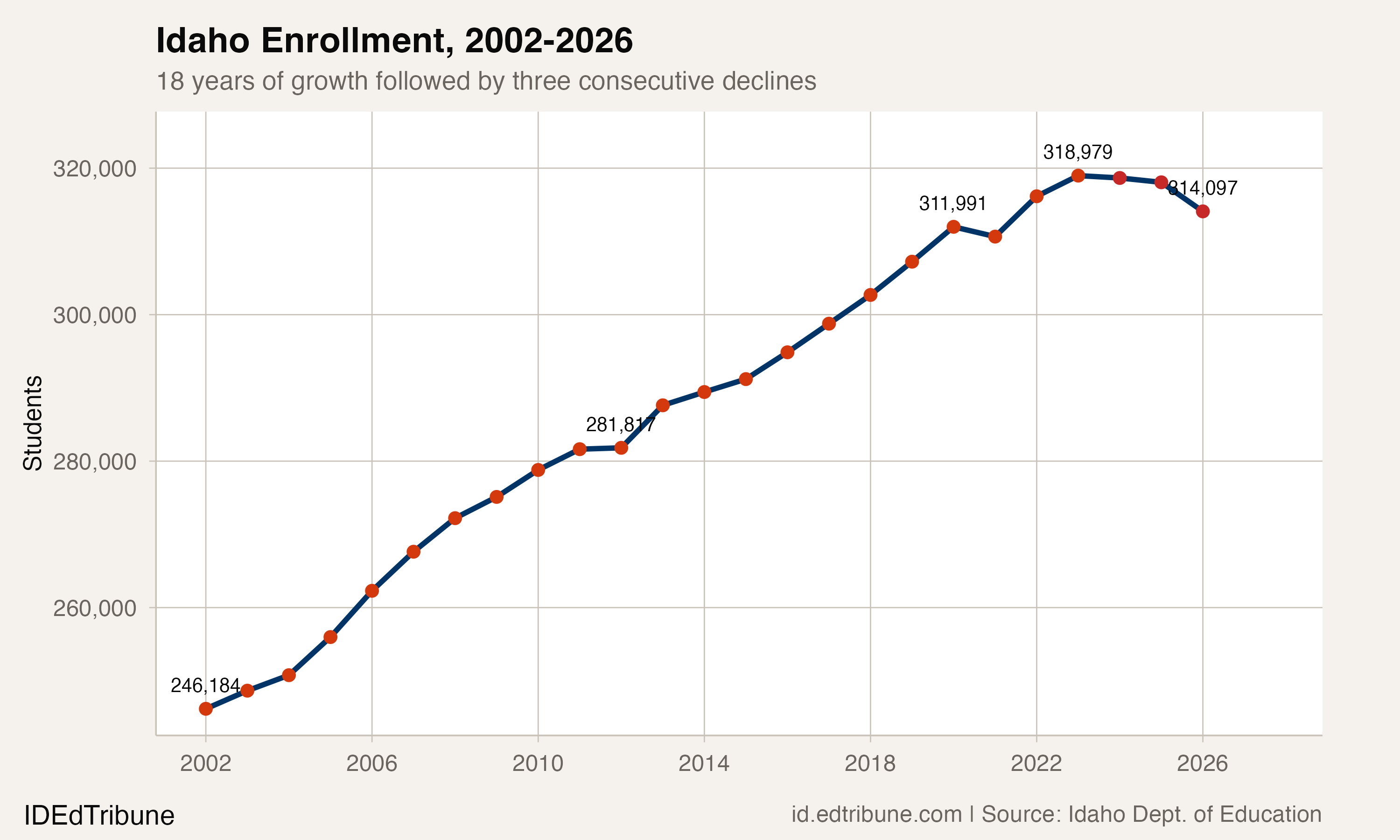
For 18 consecutive years, Idaho's public schools grew. Every fall from 2003 through 2020, more students showed up than the year before. The state added 65,807 students during that stretch, a 26.7% expansion that mirrored Idaho's reputation as one of the fastest-growing states in the country. That era is over.
Idaho's K-12 enrollment fell to 314,097 in 2025-26, a decline of 3,970 students from the prior year. It is the steepest single-year drop in the 25 years of data available, nearly triple the size of the COVID-era loss in 2020-21 and 6.7 times larger than the decline recorded just one year earlier. Enrollment has now fallen in three consecutive years since peaking at 318,979 in 2022-23, erasing 4,882 students, or 1.5% of the peak total.
The acceleration no one planned for
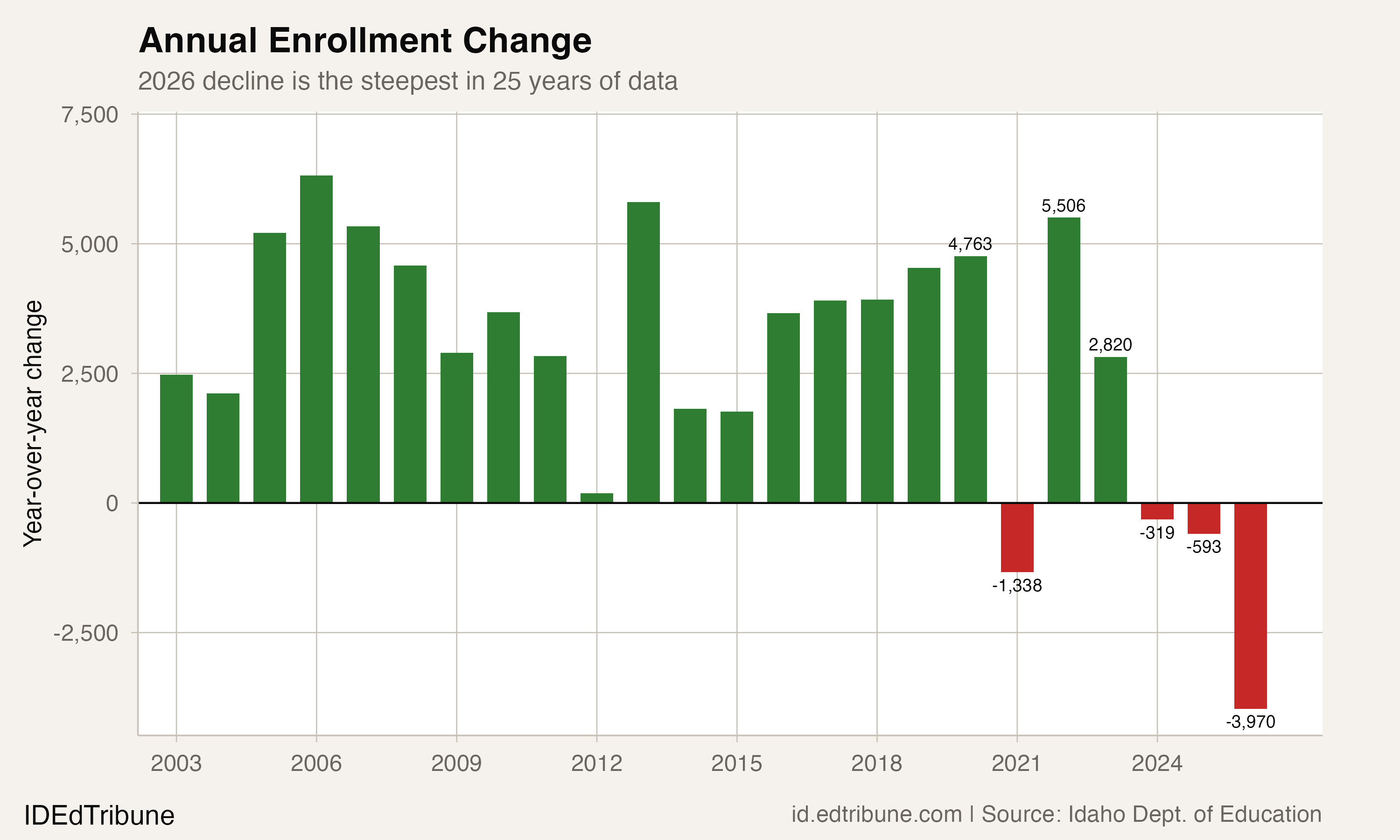
The pattern of the last three years is not gradual. It is accelerating. In 2023-24, Idaho lost 319 students, a rounding error that could be dismissed as a plateau. In 2024-25, the loss grew to 593. In 2025-26, it exploded to 3,970, a 1.25% decline that dwarfs anything in the dataset.
During Idaho's growth era, the state averaged 3,563 new students per year from 2003 to 2012, and 3,772 per year from 2013 to 2020. The post-pandemic reversal has averaged a loss of 1,627 students per year over the last three years. For budget officers accustomed to planning around growth, this is not a minor adjustment. It is a structural break.
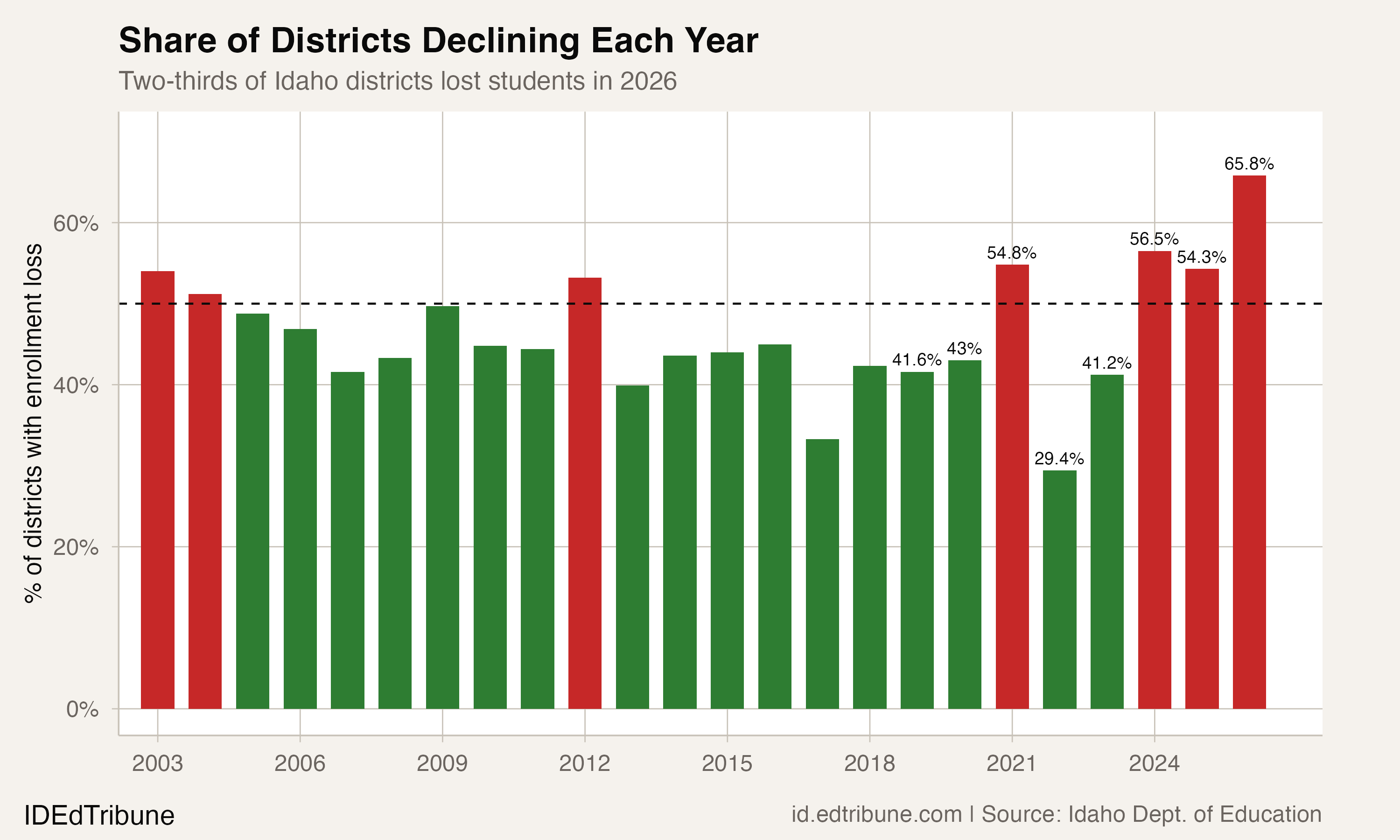
Two-thirds of Idaho's 192 districts and charter schools lost enrollment in 2025-26, the highest share in the dataset. In the post-COVID rebound year of 2021-22, only 29.4% of districts declined. Just four years later, 65.8% are shrinking.
Boise at an all-time low
The decline is concentrated at the top. The 10 districts that lost the most students in 2025-26 accounted for 75% of the statewide loss. The five largest losers alone represented half.
West Ada District↗ET, Idaho's largest, lost 538 students in 2025-26 and 1,238 since the 2023 peak, a 3.2% decline. Boise Independent District↗ET, the second-largest, is at an all-time low of 21,717 students after losing 1,168 from its peak, a 5.1% drop. Nampa School District↗ET has shed 945 students since 2023, a 7.0% decline. Pocatello District↗ET has lost 896, or 7.3%. Twin Falls District↗ET is down 588, or 6.3%.
In all, 38 districts hit all-time lows in 2025-26, including three of the state's five largest. Thirty-five districts reached all-time highs, but most of those are small charter schools and rural districts where a handful of students can set a record.
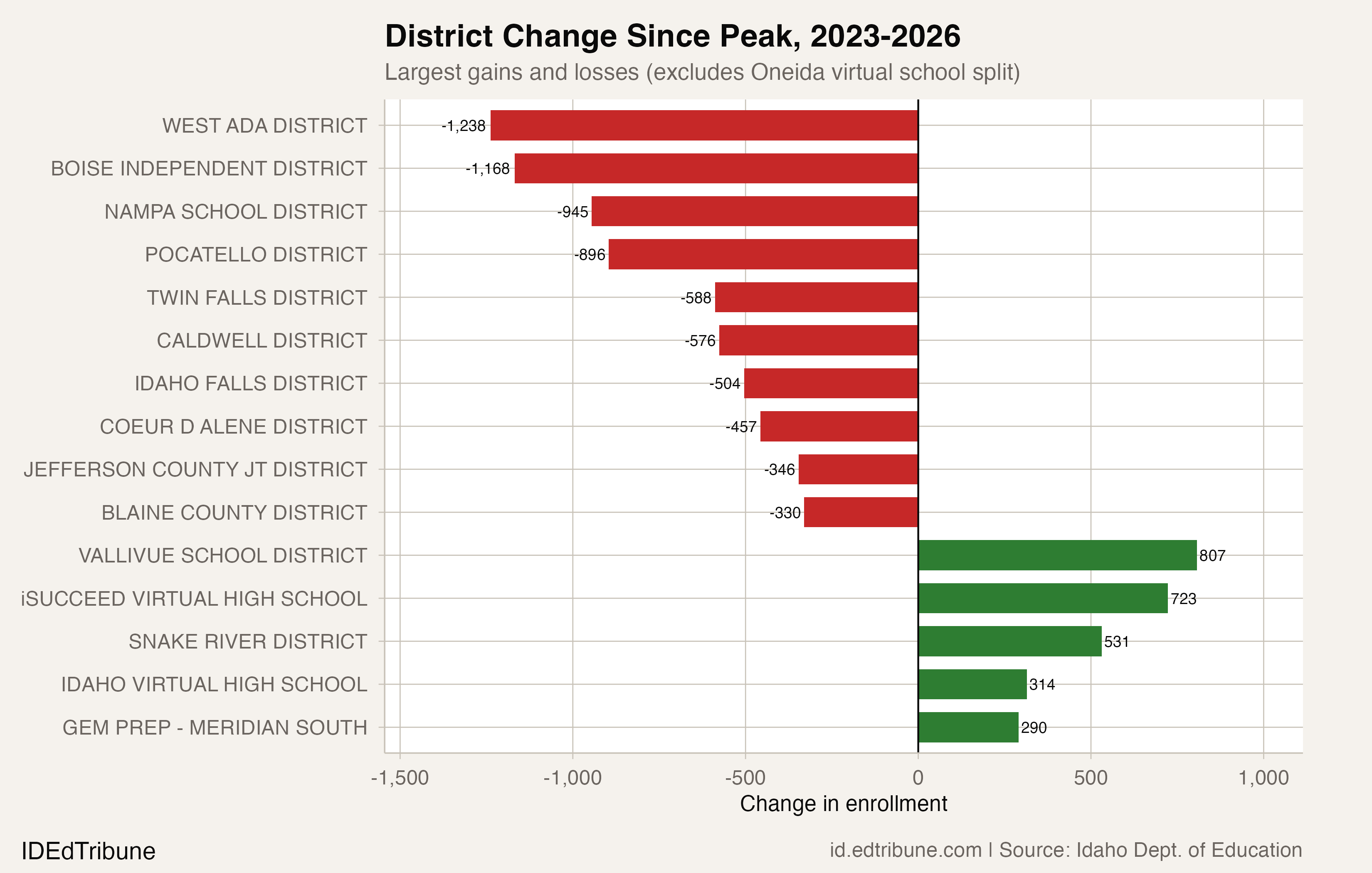
The one standout among large districts is Vallivue School District↗ET in Caldwell, which added 807 students since 2023, an 8.2% gain. Vallivue's growth aligns with Canyon County's status as a more affordable alternative to Ada County (Boise). But Vallivue is the exception. Eight of the ten largest traditional districts have declined since the peak.
Fewer kindergarteners, more seniors
The clearest signal that Idaho's decline is structural, not cyclical, comes from the grade-level pipeline. In 2002, Idaho enrolled roughly equal numbers of kindergarteners and 12th graders: 17,844 and 17,622. For 15 years, kindergarten outpaced Grade 12, a sign that more students were entering the system than leaving it.
That relationship inverted in 2018. Grade 12 enrollment surpassed kindergarten and has stayed ahead every year since. In 2025-26, the gap reached its widest point: 25,316 seniors versus 20,184 kindergarteners, a difference of 5,132 students. The K-to-G12 ratio has fallen to 0.80, meaning for every five seniors graduating out of Idaho schools, only four kindergarteners are entering.
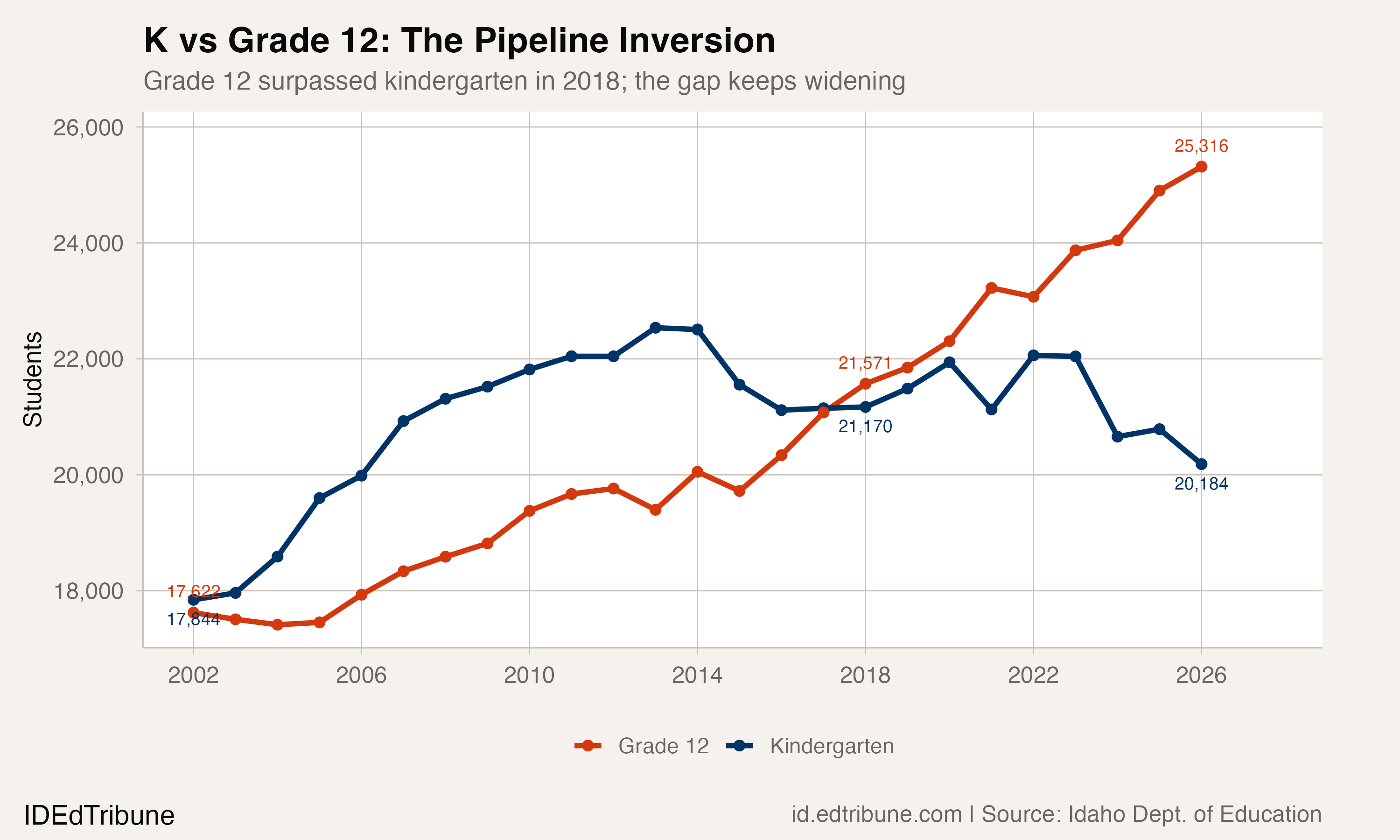
Kindergarten peaked at 22,537 in 2012-13 and has fallen 10.4% since. Grade 12, by contrast, is at its highest point ever. Those 12th graders were born in 2007-08, the peak years for Idaho births. Every graduating class after this one will come from smaller birth cohorts.
A growing state that produces fewer students
Idaho's population has grown faster than nearly every other state's, expanding 21.5% from 2012 to 2022 and surpassing two million residents in 2024. The paradox is that almost none of that growth translated into school enrollment. According to an analysis by Idaho@Work, 90% of Idaho's population growth from 2019 to 2022 came from adults over age 18. The state's population rose 45% from 2002 to 2022. Births rose just 7% over the same period.
The birth rate tells the story most directly. Idaho recorded more than 25,000 births in both 2007 and 2008, its highest levels on record. By 2021, the rate had fallen to 11.8 per 1,000, a 29% decline from the 2007 peak of 16.6. That generation of 25,000-birth cohorts is now aging out of K-12, and the smaller cohorts behind them are what kindergarten classrooms are seeing.
Housing costs compound the demographic squeeze. State Superintendent Debbie Critchfield told Idaho EdNews that rising costs "have made it harder for young families to stay or settle in Idaho, which contributes to smaller kindergarten cohorts." Ada County median home prices hover around $535,000. The newcomers driving Idaho's population boom are disproportionately retirees and remote workers, not families with school-age children.
"We know enrollment directly impacts state funding." Superintendent Debbie Critchfield, Idaho EdNews, November 2025
The funding formula amplifies the pain
Enrollment decline arrives at a particularly bad time for Idaho districts. The state's funding formula, which ties school budgets to average daily attendance rather than enrollment, means districts lose money twice: once from fewer students, and again from the gap between enrollment and attendance. Statewide, attendance averages about 92-93% of enrollment. Districts get funded on the lower number.
When the Legislature and State Board of Education allowed a pandemic-era enrollment-based funding rule to expire, the shift back to attendance-based funding cost districts an estimated $162 million. Quinn Perry of the Idaho School Boards Association warned of the impact:
"We knew and made our best attempts to warn state leaders that shifting back to attendance would bring a dramatic drop in how state funding is distributed, but it's quite distressing to see the difference." Quinn Perry, Idaho EdNews, January 2024
Most of Idaho's districts face losses under the attendance formula. Only about 50 smaller districts benefit from attendance-based funding. For a district like Boise, already at an all-time enrollment low, the combination of fewer students and a funding formula that discounts those who remain is a compounding fiscal problem.
A state that stopped building for growth
The Board of Education's 2024 demographic projections suggested no enrollment cliff was imminent, noting that migration could offset falling birth rates. The 2025-26 data challenges that optimism. The 3,970-student loss in a single year exceeds what the projections anticipated.
Nampa closed four elementary schools in the summer of 2024. Boise cut 27 positions. Coeur d'Alene is weighing budget reductions. These are not districts that planned for contraction. They budgeted for a growth state, and for 18 years the growth came. It stopped coming, and the infrastructure built for 319,000 students now serves 314,000, with a kindergarten pipeline that keeps narrowing.
Detailed code that reproduces the analysis and figures in this article is available exclusively to EdTribune subscribers.
Discussion
Sign in to join the discussion.
Loading comments...