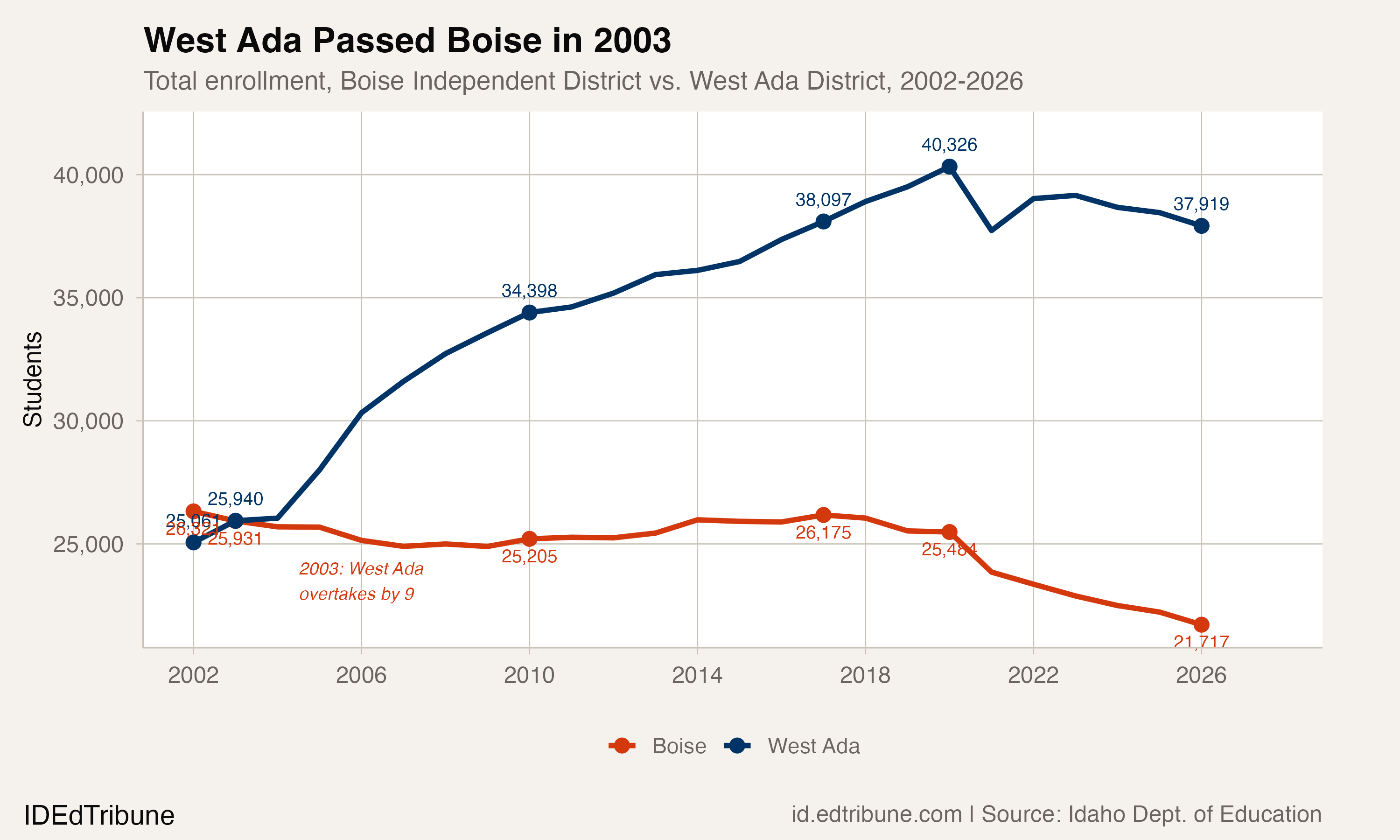
In the fall of 2002, Boise Independent District enrolled 26,321 students, making it the largest school district in Idaho. West Ada District↗ET, headquartered 10 miles west in Meridian, had 25,061. The gap was 1,260 students, and Boise's position at the top of the state had been unchallenged for decades.
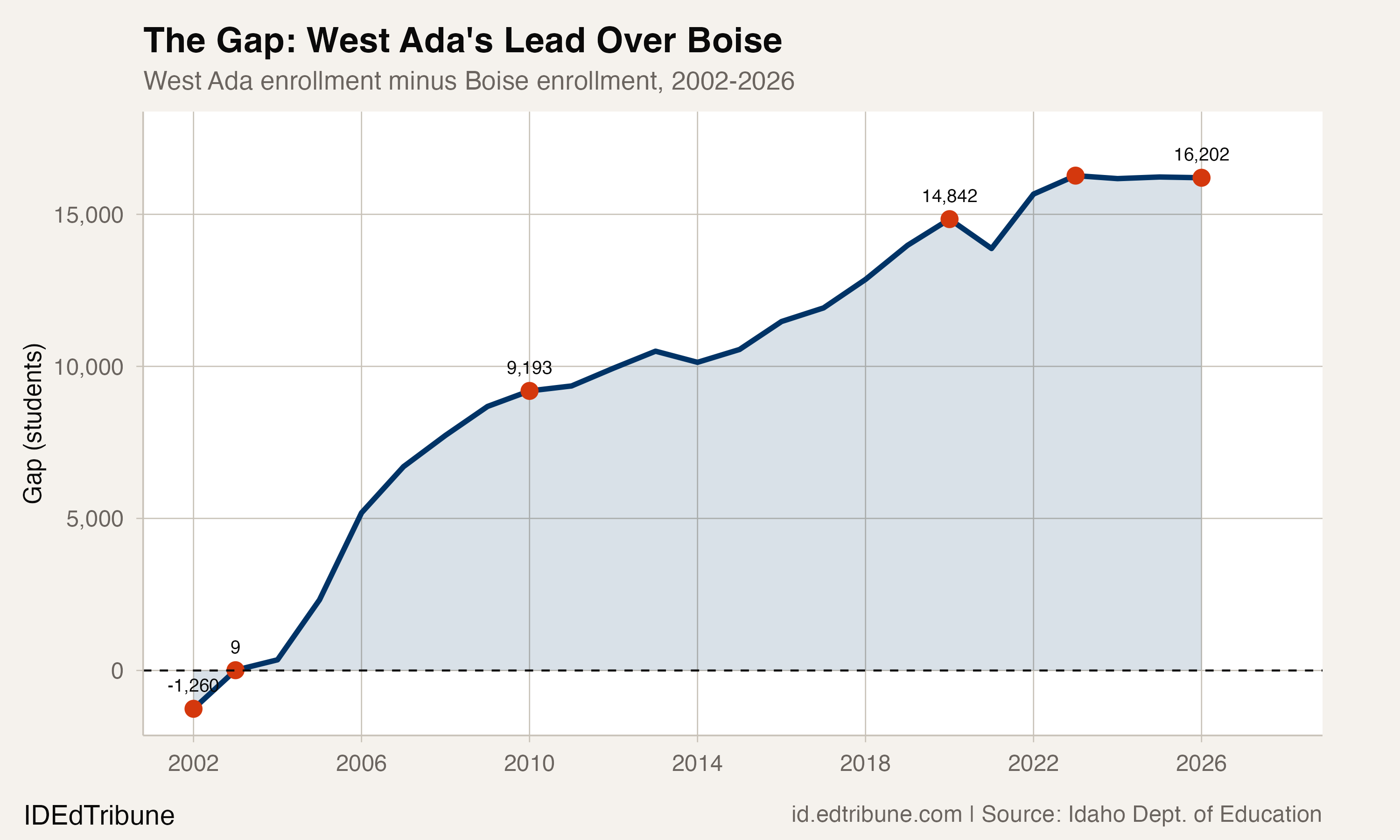
One year later, it was over. West Ada edged ahead by nine students: 25,940 to 25,931. The margin was so thin it could have been a rounding error. It was not. Boise↗ET has never reclaimed the lead, and in 2025-26 the gap between Idaho's two largest districts stands at 16,202 students, a chasm 1,800 times wider than the crack that opened it.
A gap built on geography
The crossover was not a one-year anomaly. It was the beginning of a structural divergence driven by where the Treasure Valley chose to build.
Between 2003 and 2010, West Ada added 8,458 students while Boise lost 726. By 2020, West Ada had reached 40,326, a peak that made it nearly 60% larger than Boise. The gap widened not because of a single policy decision but because Meridian, Star, and Eagle absorbed the region's housing boom while Boise's footprint stayed fixed.
West Ada's superintendent Derek Bub has described the dynamic in operational terms: the district faces "rapid growth on the two sides of our district" with immediate needs in both Star and south Meridian. West Ada recently broke ground on a new $20 million elementary school in Star, funded by House Bill 521, which provided the district more than $150 million in 2024. The district is simultaneously searching for land in south Meridian for another school.
Boise, by contrast, is managing contraction. The district cut 27 full-time positions, including nine elementary teachers, 17 secondary teachers, and one assistant principal, to align staffing with declining headcount.
Both districts are now shrinking
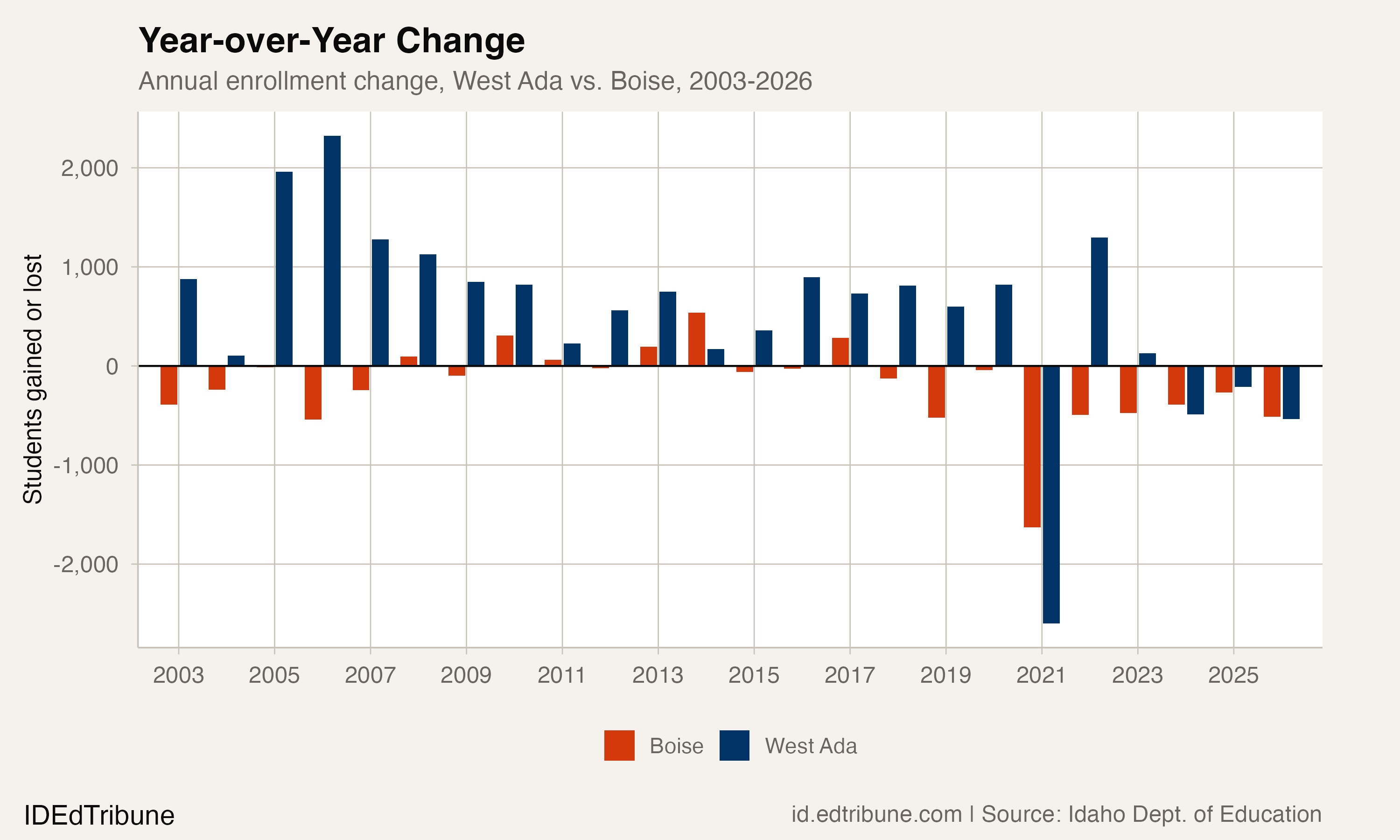
The most consequential shift in recent years is that West Ada's growth engine has stalled. After peaking at 40,326 in 2019-20, West Ada has lost 2,407 students, a 6.0% decline. The district shed 538 students in 2025-26 alone, its largest single-year loss outside the pandemic.
Boise's decline is steeper and longer. The district has lost students in nine consecutive years since 2017-18, dropping from 26,175 to 21,717, a loss of 4,458 students (17.0%). Its 2025-26 enrollment of 21,717 is the lowest in the 25-year dataset and, according to district officials, the lowest average daily attendance since 1983-84.
The pandemic year of 2020-21 hit both districts hard but disproportionately: West Ada lost 2,597 students while Boise lost 1,630. West Ada recovered most of those losses within a year. Boise never recovered any of them.
Housing costs and an aging city
Boise school officials have pointed to a cluster of reinforcing factors. Rising housing costs top the list. Ada County average home sale prices exceed $500,000, and Boise-area housing costs have more than doubled over the past decade. That cost burden falls hardest on families with children, who need more bedrooms and more space.
"The rise in housing costs and shifting community demographics have led some families to move to more affordable or rural areas." Source: West Ada School District
The irony is that both districts cite the same phenomenon. Boise's officials note that the city is attracting older adults and retirees at higher rates than families, while declining birth rates in Ada County shrink the pipeline of incoming kindergartners. West Ada's officials cite housing costs pushing families to more affordable districts even farther out.
Terry Ryan, CEO of Bluum, a nonprofit involved in charter school growth, offered a regional frame: "We're seeing this in places like Denver and Salt Lake City, these Western cities where there's a bunch of growth, but it's not in the typical boundaries of the big city. It's in the suburbs."
The kindergarten pipeline makes the trend visible at the entry point. Boise enrolled 1,868 kindergartners in 2001-02. In 2025-26, it enrolled 1,269, a 32.1% decline. West Ada's kindergarten class also fell from its 2019-20 peak of 2,626 to 2,210 in 2025-26, a 15.8% drop, suggesting the same birth-rate and affordability pressures are beginning to reach the suburbs.
The ring beyond the ring
The pattern extends past both districts. Smaller Treasure Valley districts farther from Boise's core have grown far faster than West Ada, which is itself already a growth story.
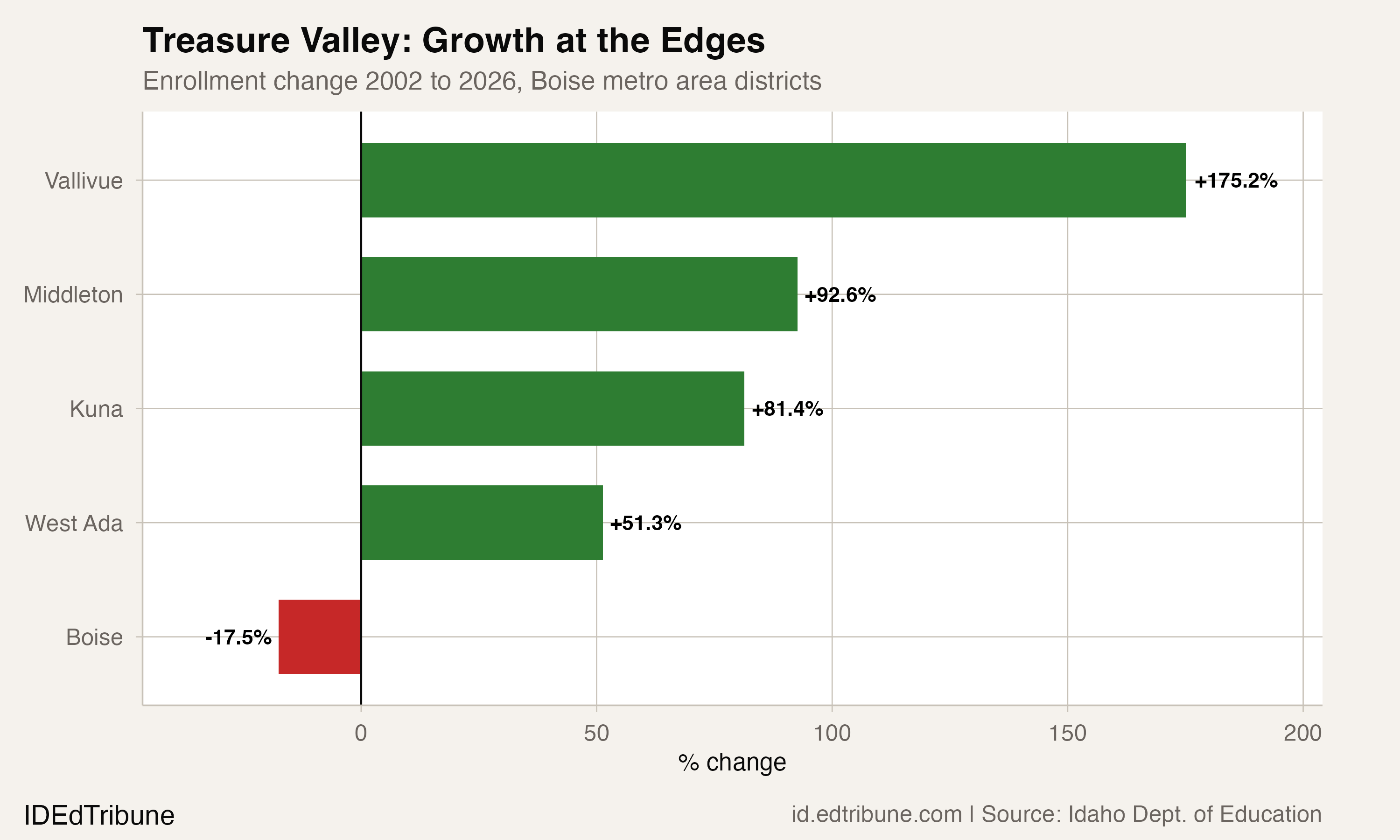
Vallivue School District↗ET in Caldwell grew 175.2% since 2002, from 3,888 to 10,700 students. Middleton↗ET nearly doubled at 92.6%. Kuna↗ET grew 81.4%. Even West Ada's 51.3% growth, which added 12,858 students in absolute terms, lags the percentage gains of its smaller neighbors.
This is the classic suburban-ring pattern: growth radiates outward from the core city, first to the inner suburbs (West Ada's 2000s boom), then to the exurban fringe (Vallivue, Kuna, and Middleton's sustained growth through the 2020s). Boise's 17.5% decline over the same period makes it the only Treasure Valley district losing students.
What state share reveals
The divergence is not just a local story. In 2002, Boise and West Ada each enrolled about 10% of Idaho's students: Boise at 10.7%, West Ada at 10.2%. Together they served one in five students statewide.
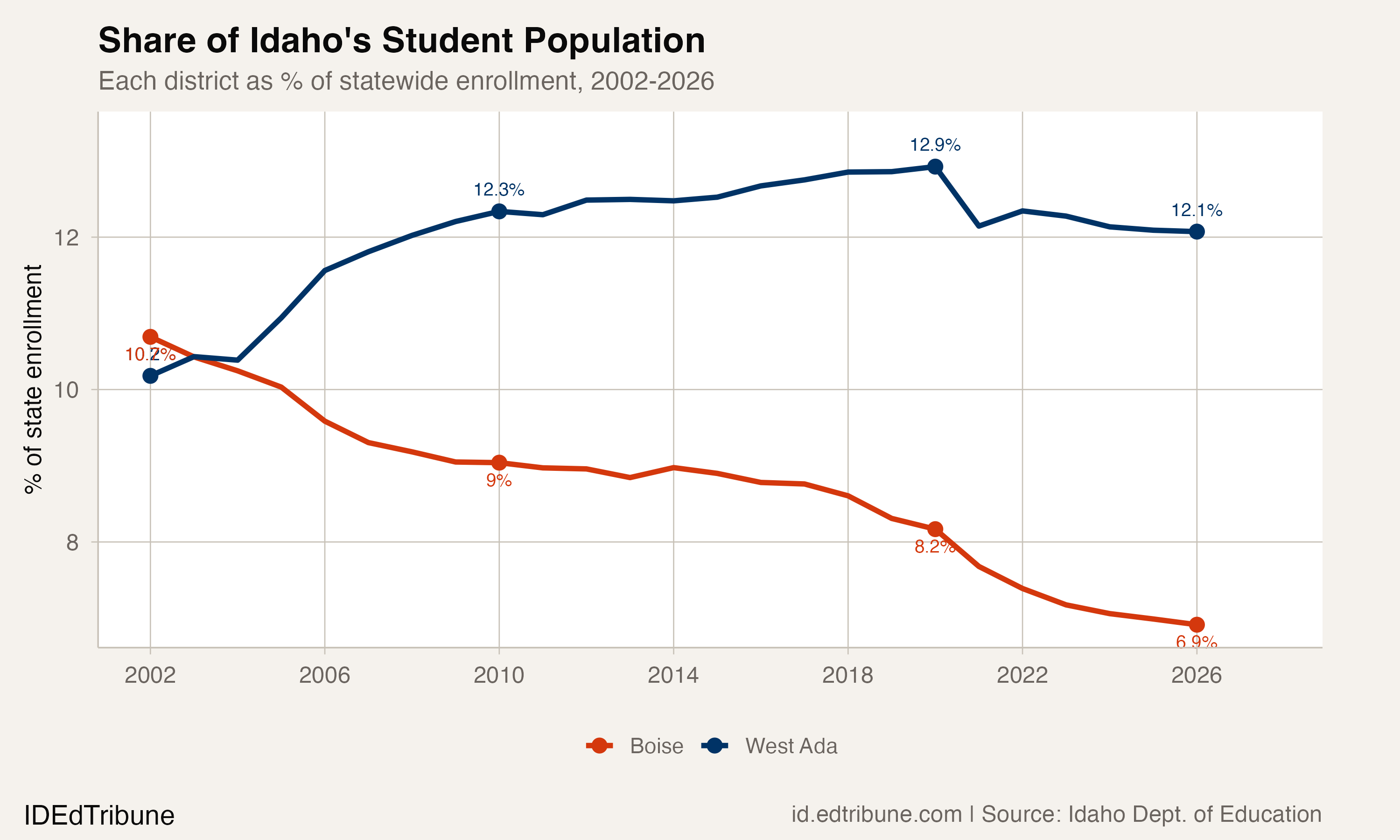
By 2025-26, those paths have split. West Ada educates 12.1% of Idaho's students; Boise educates 6.9%. Their combined share has dropped from 20.9% to 19.0%, meaning Idaho's student population has grown faster than these two districts combined. Growth has dispersed across the state's many smaller districts and a wave of new charter schools.
What comes next
The gap between West Ada and Boise has effectively plateaued since 2022, hovering between 15,665 and 16,272. That plateau is not stability. It reflects two districts declining at roughly similar rates: West Ada lost 538 students in 2025-26, Boise lost 513. If both continue shrinking at comparable rates, the gap will persist even as both districts face the budget pressure of fewer students and less state funding.
West Ada has 14,000 approved housing sites within its boundaries. Boise has not recorded a single year of growth since 2016-17. The nine-student margin of 2003 was never really about nine students. It was the first visible sign that the Treasure Valley's center of gravity had shifted west. Twenty-three years later, West Ada is breaking ground on a $20 million elementary in Star. Boise is cutting 27 positions. The gap between the two districts has stopped widening, but only because they are now falling together.
Detailed code that reproduces the analysis and figures in this article is available exclusively to EdTribune subscribers.
Discussion
Sign in to join the discussion.
Loading comments...