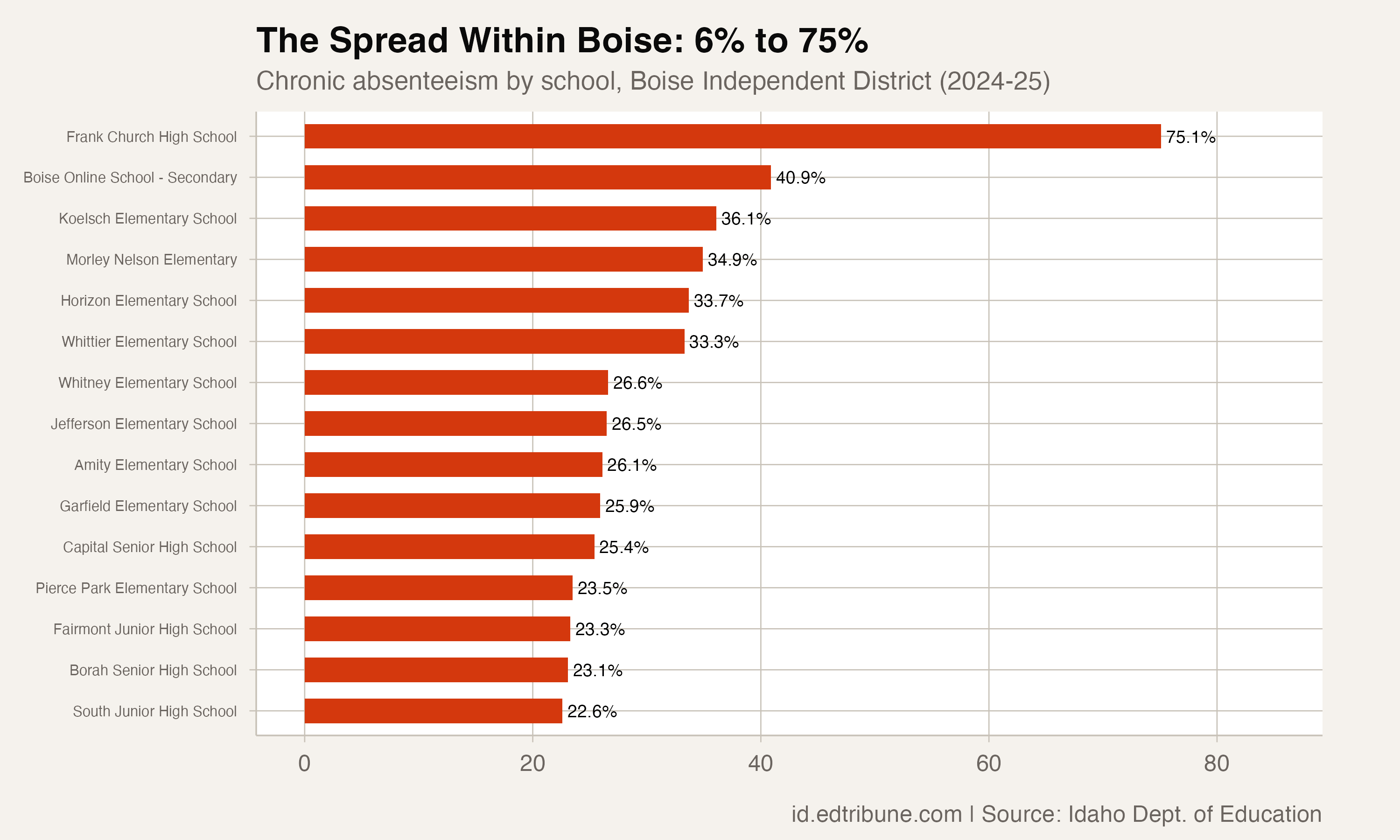
Longfellow Elementary School on Boise's North End has a 6.2% chronic absenteeism rate. Twelve miles south, Frank Church High School sits at 75.1%. They are in the same school district.
That 69-point spread captures something the district average obscures: Boise Independent District↗ET's 21.0% chronic absenteeism rate is not a single problem with a single cause. It is the arithmetic mean of schools operating in different realities: some with attendance patterns any district in the country would envy, others where three-quarters of students miss at least 18 days a year.
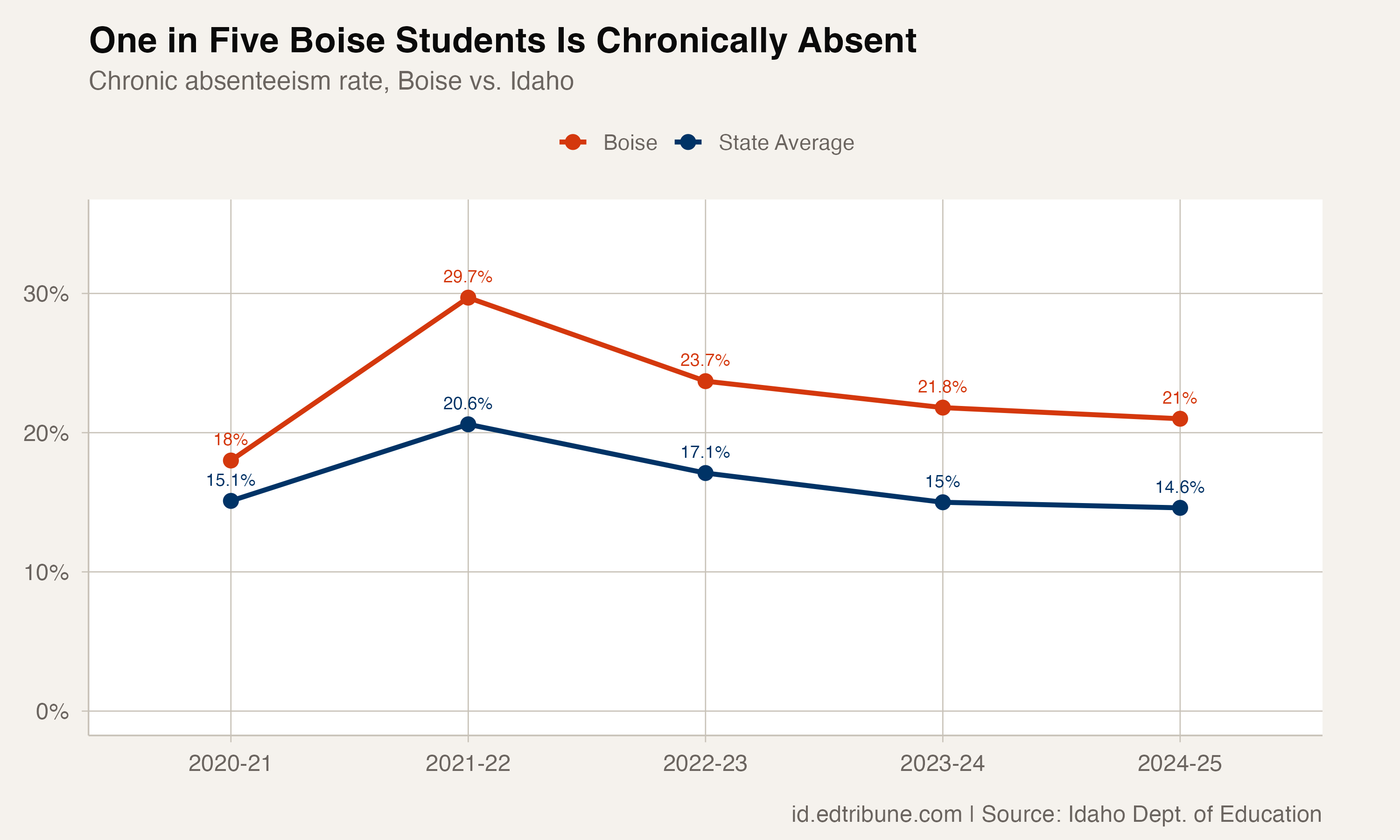
Still above where it started
Boise's 2024-25 rate of 21.0% represents steady improvement from a pandemic peak of 29.7% in 2021-22. The recovery trajectory (29.7%, 23.7%, 21.8%, 21.0%) has been consistent but slow. The district has not returned to its 2020-21 level of 18.0%, and the year-over-year gains are shrinking: 6.0 points, then 1.9, then 0.8.
At this deceleration rate, Boise may not reach its 2021 level for another two to three years. And 2021 was already a pandemic-affected year, not a true baseline.
The gap between Boise and the state average has been persistent. In 2020-21, Boise ran 2.9 points above the state. Now it runs 6.4 points above. The state improved; Boise improved less.
Where the absences concentrate
Within Boise's 48 schools, the distribution tells a clear story. Removing Frank Church (the alternative high school) and the two Boise Online School campuses, the pattern maps closely to socioeconomic geography:
The highest-rate traditional schools cluster in southwest and central Boise, neighborhoods with higher poverty and more apartment housing. Koelsch Elementary (36.1%), Morley Nelson Elementary (34.9%), Horizon Elementary (33.7%), and Whittier Elementary (33.3%) all sit above 30%.
The lowest rates are in north and east Boise, the city's most affluent neighborhoods. Longfellow (6.2%), Highlands (7.8%), Adams (8.8%), and Riverside (9.9%) all run below 10%.
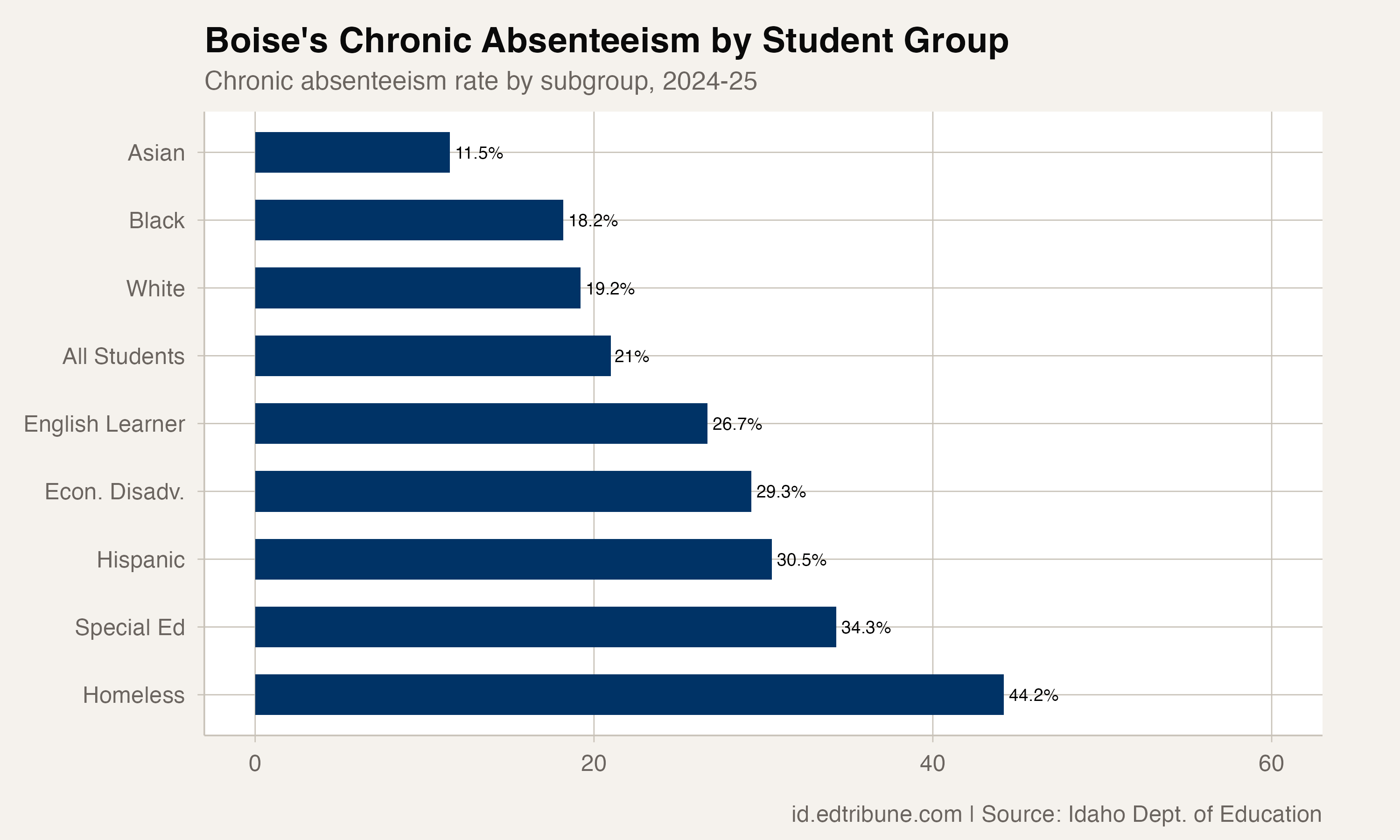
The subgroup picture
Nearly half of Boise's students who are currently homeless (44.2%) are chronically absent, the district's highest-rate subgroup. Students receiving special education services face a 34.3% rate. Hispanic students, 15.9% of enrollment, sit at 30.5%.
Students who are economically disadvantaged have a 29.3% rate, 10 points above the district average and concentrated in the same southwest Boise schools that top the school-level list. White students, 68.4% of enrollment, face a 19.2% rate, above the statewide white rate of 12.9%.
Idaho's capital, Idaho's biggest attendance problem
With 4,545 chronically absent students, Boise accounts for roughly 10% of all chronically absent students in Idaho despite enrolling 7% of the state's students. The absolute numbers dwarf any other district in the state: Meridian (Joint School District No. 2), with nearly double the enrollment at 38,375, has a 14.3% rate that produces about 5,488 chronically absent students. Boise produces 4,545 from a much smaller enrollment base.
The distinction matters because Boise's rate problem is partly an intensity problem. A higher share of Boise's students cross the chronic threshold, and the district has more schools where absence is concentrated in crisis-level pockets.
Boise has invested in community partnerships and family engagement strategies to address attendance. The district's partnership with United Way of Treasure Valley and its attendance intervention team have focused on the schools with the highest rates. But with 24 of 48 schools still above 20% chronic absenteeism, and the overall rate stuck above pre-pandemic levels, the capital district remains a case study in how hard it is to move a stubborn attendance needle.
Idaho's education policy is made in Boise. So is the state's attendance crisis.
Detailed code that reproduces the analysis and figures in this article is available exclusively to EdTribune subscribers.
Discussion
Sign in to join the discussion.
Loading comments...