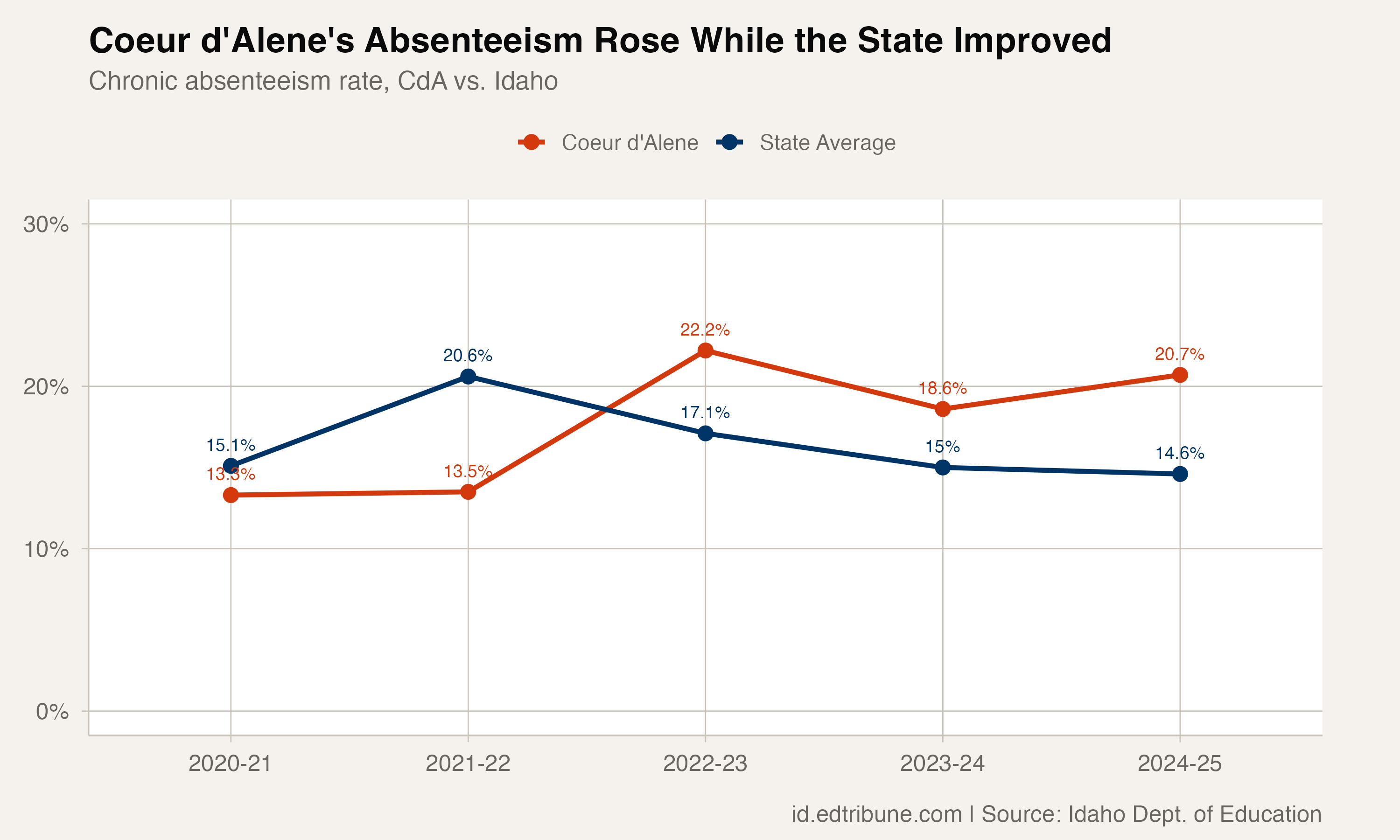
In 2020-21, Coeur d'Alene↗ET's chronic absenteeism rate sat comfortably below the state average: 13.3% to Idaho's 15.1%. By 2024-25, the lines had crossed. Coeur d'Alene climbed to 20.7% while Idaho fell to 14.6%.
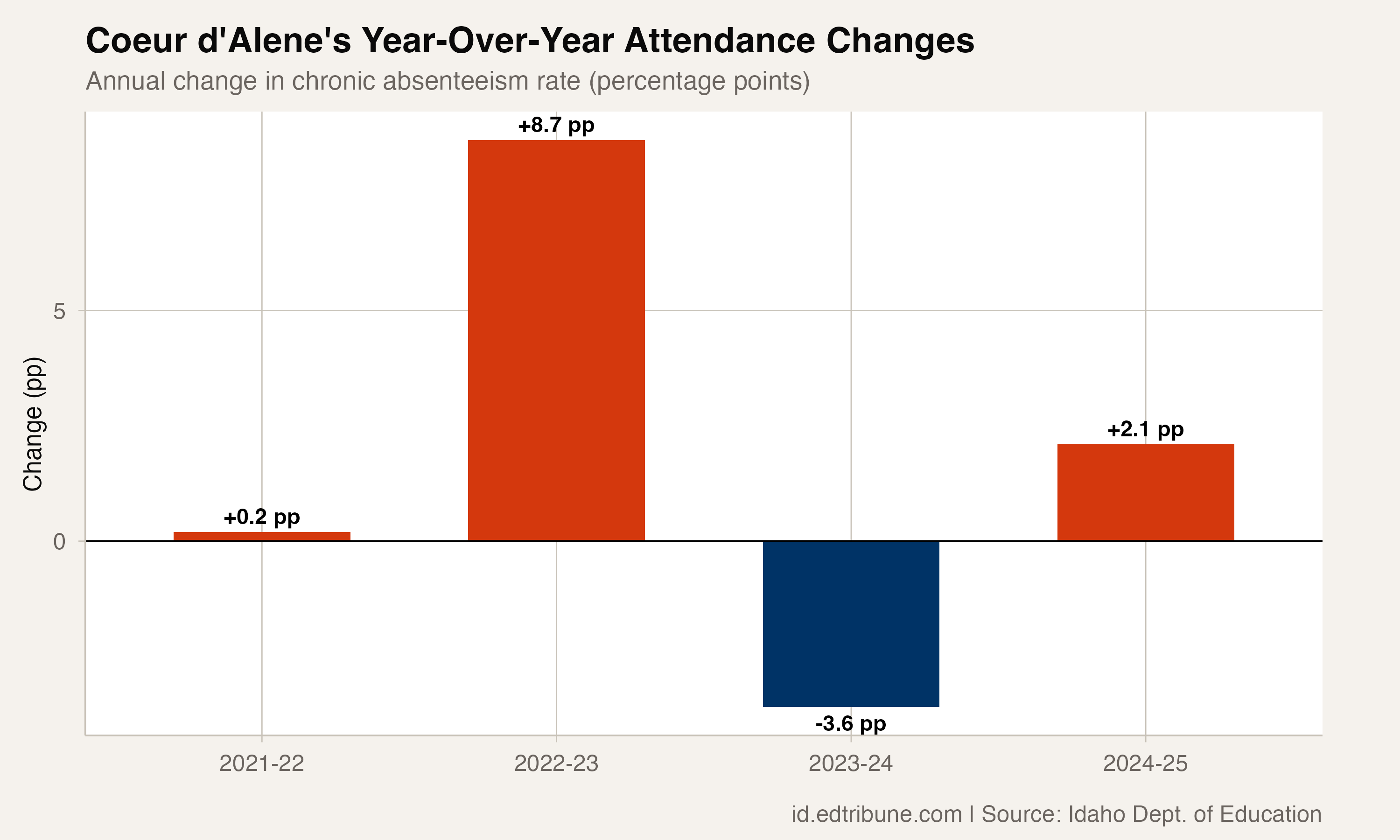
The reversal happened suddenly. After two years of relative stability (13.3% and 13.5%), Coeur d'Alene's rate spiked to 22.2% in 2022-23, an 8.7-point jump in a single year that coincided with a wave of illness-related absences the district has attributed to post-pandemic health patterns. The rate partially recovered in 2023-24, falling to 18.6%, but then climbed again to 20.7% in 2024-25, suggesting the initial spike was not a one-year anomaly but the beginning of a structural shift.
The cost of empty seats
The Coeur d'Alene Press reported that the district lost an estimated $4.8 million in state funding due to absences. Idaho pays districts based on Average Daily Attendance, so every empty seat reduces revenue directly.
With 9,484 students and a 20.7% chronic rate, roughly 1,965 students are missing at least 18 school days per year. District leaders have pointed to illness-related absences rising 53%, dental and medical appointments up 46%, and vacation absences up 32% as the primary drivers. The portrait is one of a community where families increasingly treat school attendance as flexible rather than mandatory.
A community problem, not a demographic one
Coeur d'Alene's attendance problem cuts across student groups. White students, 83.7% of the district, have a 19.7% chronic rate, well above the statewide white rate of 12.9%. Economically disadvantaged students face a 28.9% rate. Special education students are at 27.9%. Hispanic students, 8.9% of enrollment, sit at 27.6%.
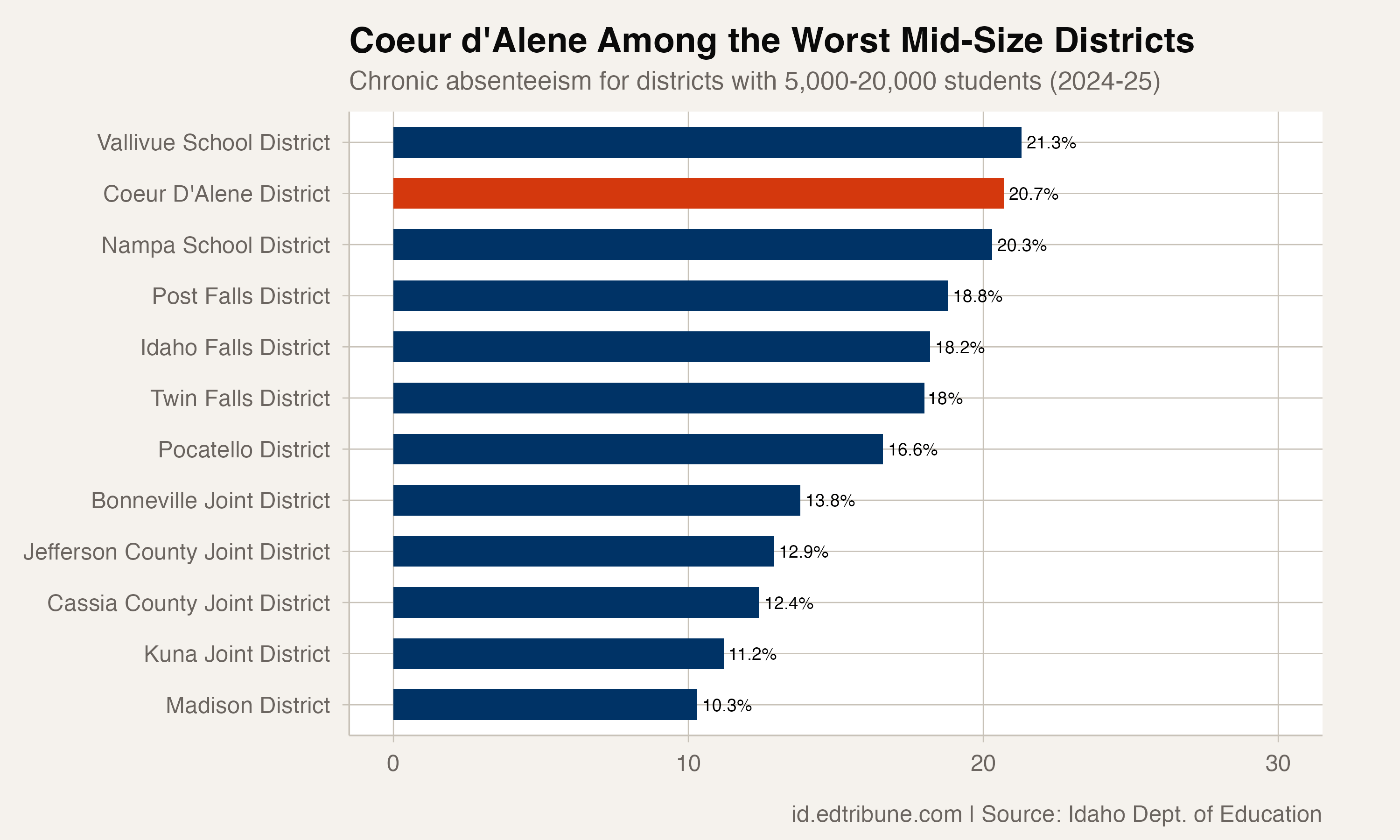
The most striking comparison may be with similarly sized districts. Among Idaho's 13 districts with 5,000 to 20,000 students, Coeur d'Alene has the second-highest chronic rate after Vallivue (21.3%). Madison District, a similar-sized district in eastern Idaho, posts just 10.3%.
Where the problem concentrates
Within Coeur d'Alene, Venture Academy, an alternative school, leads at 36.9%. But the problem extends well beyond alternative settings. Lakes Middle School hits 30.3% with 528 students. Woodland Middle School is at 27.4% with 745 students. These are large, mainstream schools.
Even Coeur d'Alene High School, the district's flagship with 1,473 students, posts a 17.9% chronic rate. Lake City High School, the other large high school, sits at 21.4%. The only school-level bright spot is Coeur d'Alene Charter Academy, at 9.4% with 562 students, operating under the same community conditions but producing a dramatically different attendance outcome.
The regional context
Coeur d'Alene's worsening sits within a broader pattern in northern Idaho's Kootenai County, where population growth, rising housing costs, and a post-pandemic cultural shift around school attendance norms have created headwinds for districts. The region has also been a hub for families who relocated during and after the pandemic, bringing different attitudes toward institutional schooling.
Post Falls, the neighboring district, also sits above the state average at 18.8%. Lakeland, further west, is at 12.6%. The Coeur d'Alene-Post Falls corridor, Idaho's fastest-growing metropolitan area outside Boise, is producing some of the state's worst attendance outcomes.
The district started 2020-21 below the state average and ended 2024-25 six points above it. For a district of nearly 10,000 students, the attendance data is telling a story the test scores and graduation rates are not.
Detailed code that reproduces the analysis and figures in this article is available exclusively to EdTribune subscribers.
Discussion
Sign in to join the discussion.
Loading comments...