Correction (September 30, 2026): An earlier version of this article, headlined "Snake River District's 3.1% Rate Shows What's Possible in Rural Idaho," presented Snake River's district-wide 3.1% chronic absenteeism rate as one of the lowest in Idaho and as proof that a 3% rate is achievable in a district of its size. That figure is not a reliable measure of attendance in Snake River's schools. In 2024-25, 2,447 of the district's 3,701 students (66%) were in school rows the state did not publish, including Snake River Online, the district's online school. Across the four schools that did publish counts, the rate was 7.8%. The earlier version also ranked Snake River sixth among Idaho's lowest-rate districts and described a cluster of neighboring districts with rates near 5%; several of those rates, and the top of that ranking, come from districts where no school publishes counts at all. We rebuilt the article around the schools that publish their numbers, replaced the charts, and removed the ranking and the explanation built on the cluster.
At Snake River District↗ET's high school, junior high and middle school, 182 of 1,151 students were chronically absent in 2022-23. That was 15.8%. Two years later the same three schools counted 84 chronically absent students out of 1,111, a rate of 7.6%.
That 8.2-point drop cut the rate in half. Idaho's statewide rate was 14.6% in 2024-25, so Snake River's secondary schools now sit at roughly half the state level.
Every secondary school improved
The improvement was not one school carrying the rest. Snake River Junior High went from 22.7% to 7.2%. Snake River High School went from 11.1% to 4.2%. Snake River Middle School moved less, from 18.8% to 15.4%.
Most of the drop came in a single year. The three schools combined fell from 15.8% to 8.5% in 2023-24, then to 7.6% in 2024-25. The state went from 17.1% to 14.6% over the same two years.
Rockford Elementary School, the one elementary school that published counts in 2024-25, was at 9.8%.
Why we no longer use the district-wide rate
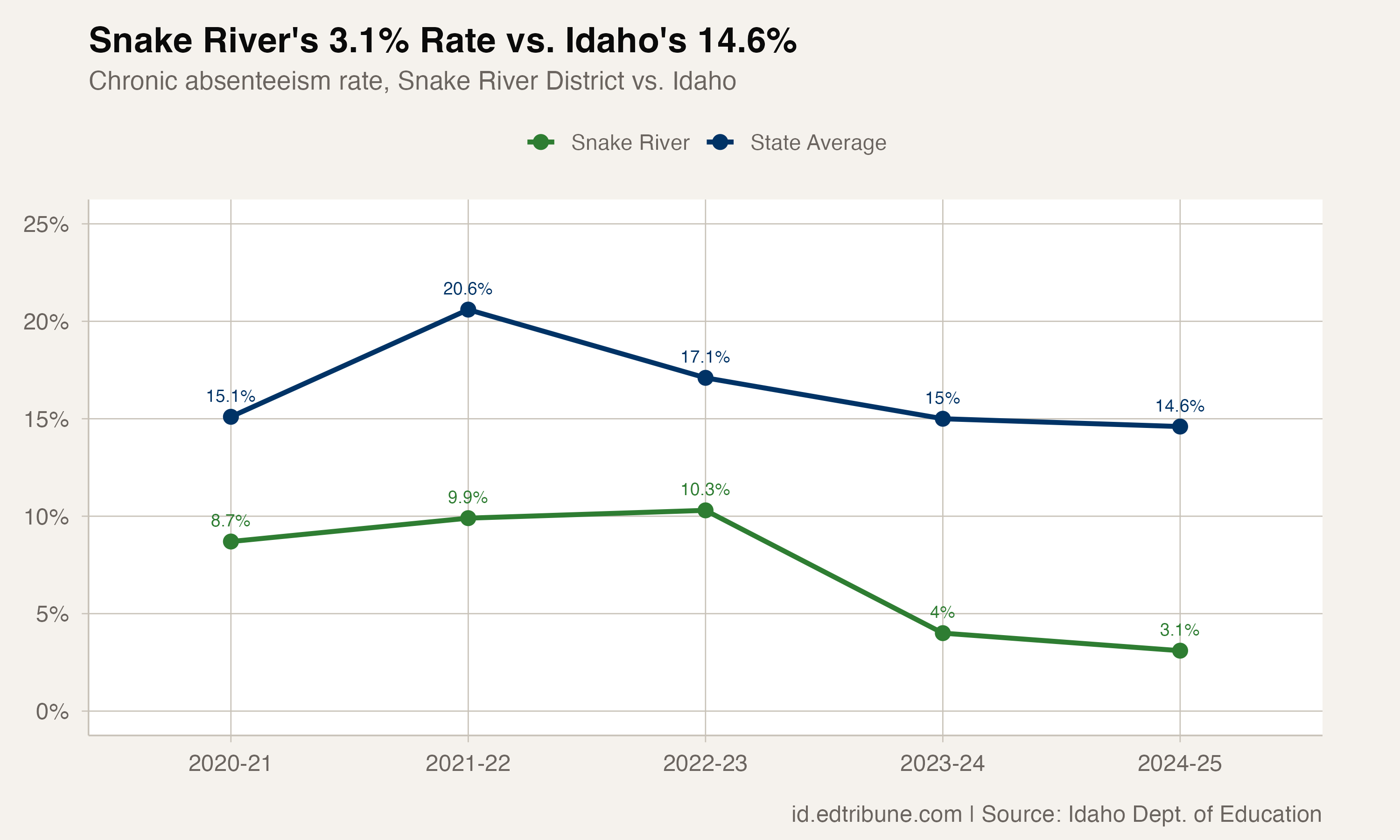
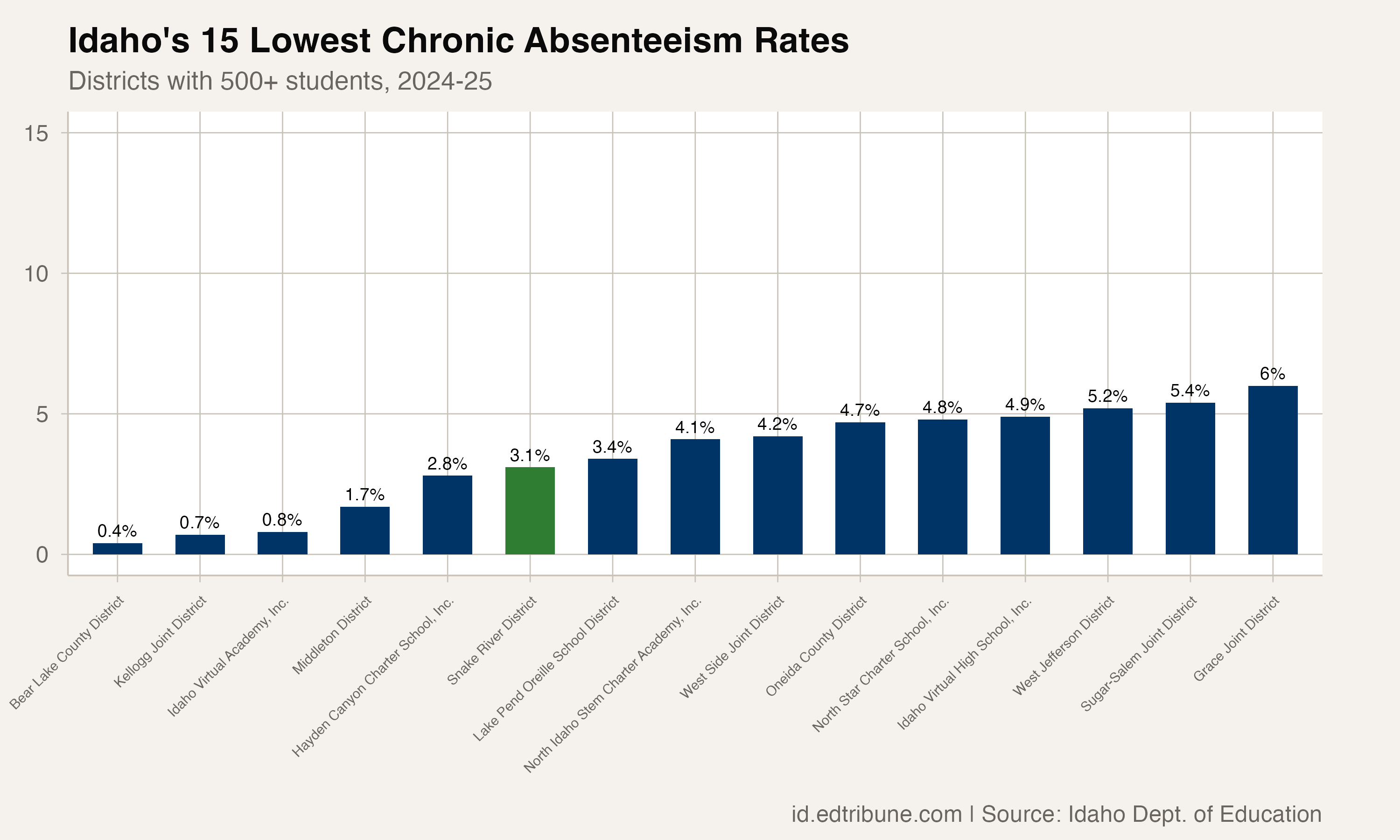
Snake River's district-wide rate for 2024-25 is 3.1%, and that is the number the first version of this story was built on. It counts every student in the district, but the state published attendance counts for only four of Snake River's schools. Across those four schools, 98 of 1,254 students were chronically absent, a rate of 7.8%.
The other 2,447 students, 66% of the district, were in school rows with no published counts. They include Snake River Online, two elementary schools and two alternative high school programs. The state's file does not say why each row was withheld, so we cannot say how many of those students attend online or what their attendance looked like. What we can say is that the district-wide figure is not something the district's own school data can confirm, and it should not be compared with other districts' rates.
The district's enrollment has grown fast, from 2,245 students in 2020-21 to 3,701 in 2024-25. The three secondary schools did not drive that growth: they enrolled 1,177 students in 2021-22 and 1,111 in 2024-25. Most of the district's added students are in the rows the state does not publish.
How the neighbors compare
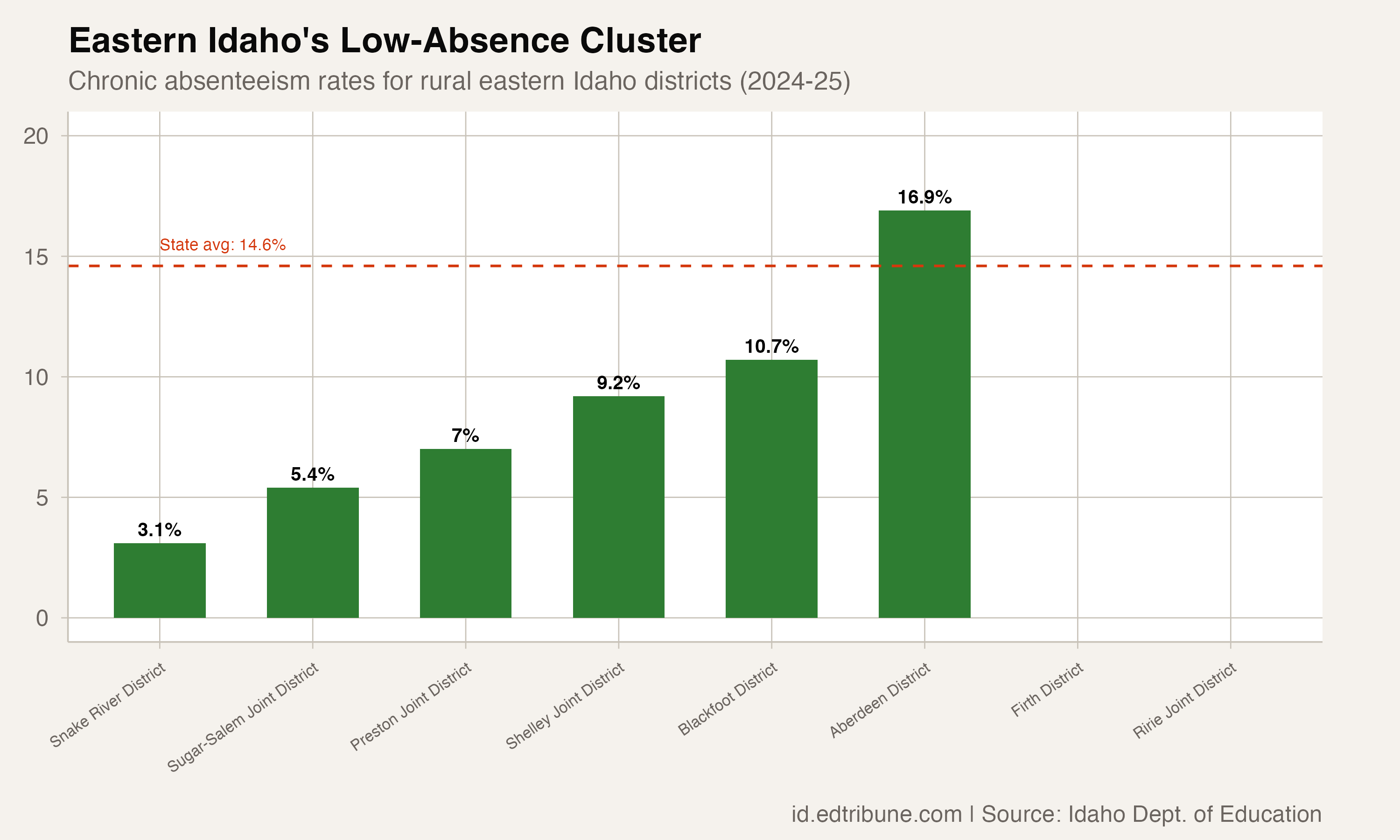
Comparing districts fairly means using the same kind of number for each: the rate across each district's schools that publish counts. On that basis, Snake River's 7.8% is among the lowest in its part of eastern Idaho, but it is not alone. Preston's schools were at 7.0% and Sugar-Salem's at 7.3%. Shelley was at 9.2%, Blackfoot at 11.4%, Jefferson County at 12.9% and Aberdeen at 16.9%.
Two other neighbors in the first version, Firth and Ririe, publish no school-level counts, so their rates cannot be checked this way and are left out. The same is true of the districts that topped the first version's statewide ranking, such as Bear Lake County and Kellogg: none of their schools publish counts.
What Snake River does show
Snake River's three secondary schools, which enrolled 1,111 students in 2024-25, went from roughly one student in six chronically absent to about one in thirteen in two years, and every one of those schools improved. That is a measurable result that holds up at the school level.
It is a smaller claim than the first version of this story made. The data does not show that a district-wide rate near the first version's figure is within reach for a district this size. It shows that a rural district's middle and high schools can cut chronic absence sharply and quickly, and that is worth understanding on its own terms.
Data from the Idaho State Department of Education. District comparisons use the rate across each district's schools with published counts, 2024-25.
Detailed code that reproduces the analysis and figures in this article is available exclusively to EdTribune subscribers.
Discussion
Sign in to join the discussion.
Loading comments...