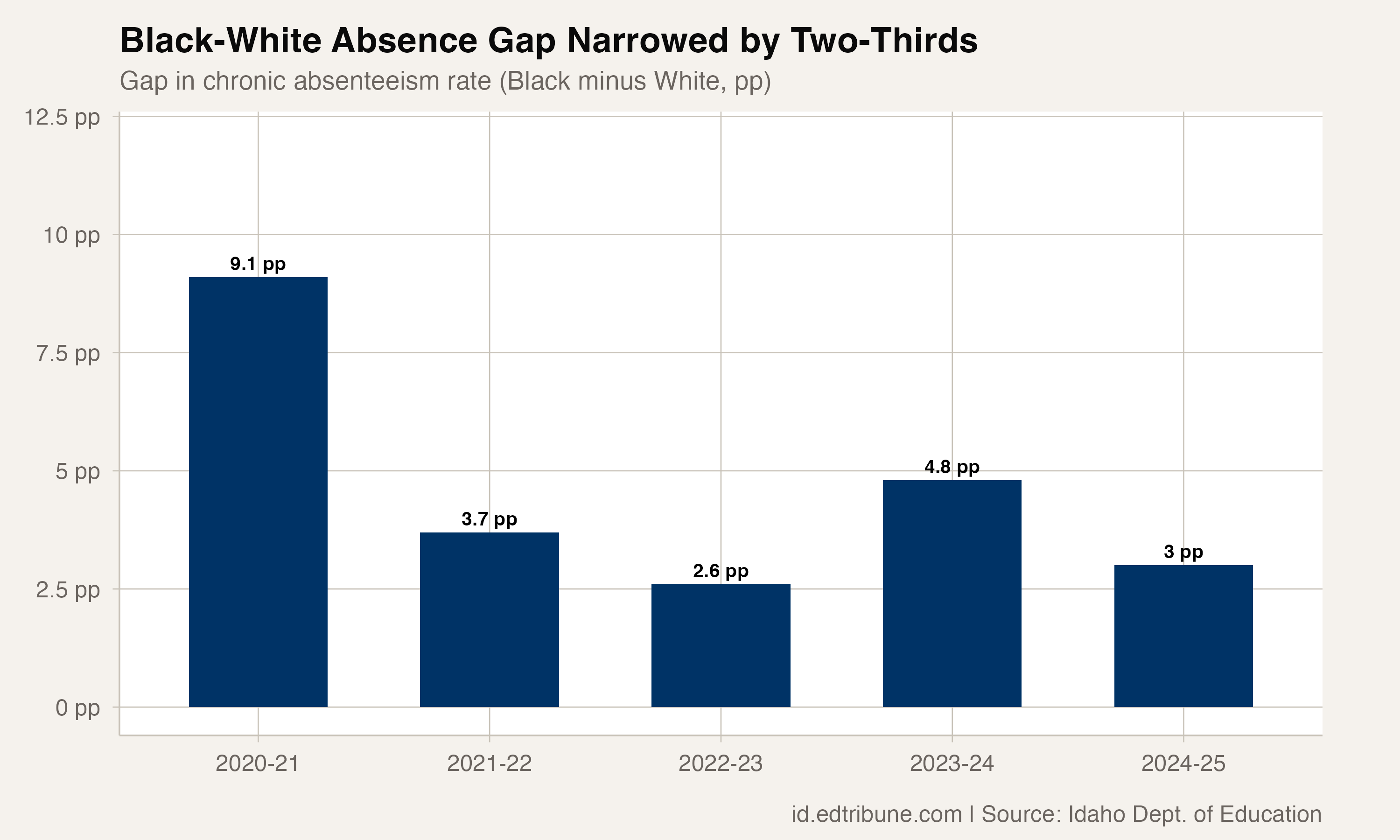
In 2020-21, a Black student in Idaho was roughly 70% more likely to be chronically absent than a white student. By 2024-25, that disparity had shrunk to 23%.
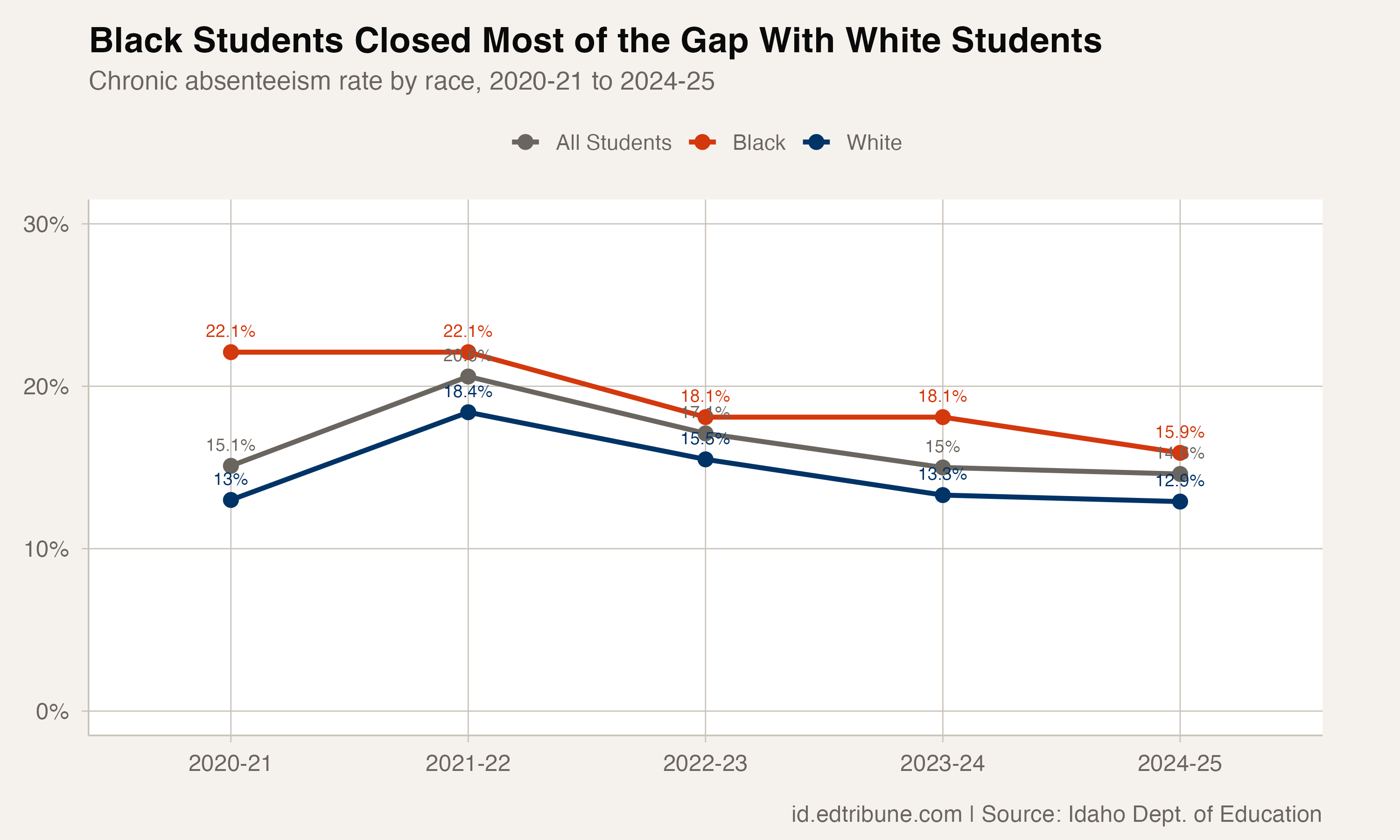
The numbers are straightforward: Black students dropped from a 22.1% chronic absenteeism rate to 15.9%, a 6.2-point improvement. White students went from 13.0% to 12.9%, essentially unchanged. The gap narrowed from 9.1 percentage points to 3.0, a reduction of two-thirds.
A narrowing driven by one side
What makes this gap closure noteworthy is that it happened almost entirely because Black students improved, not because white students worsened. In many states, pandemic-era gap narrowing was an artifact of everyone getting worse at different rates. Idaho's version is genuine: Black students' chronic rate fell by 6.2 points while the state average dropped just 0.5 points and the white rate barely budged.
The Black rate moved downward in stages rather than all at once: 22.1% through the pandemic peak (when white students spiked to 18.4%), then 18.1%, 18.1%, and 15.9%. Notably, Black students did not see the pandemic-era attendance spike that pushed up the white and statewide rates in 2021-22, which is part of why the gap closed so sharply that year. That pattern may partly reflect the small population size (3,299 students in 2021, growing to 3,827 by 2025) and the concentration of Black students in Boise-area schools that maintained in-person instruction.
The Hispanic gap tells a different story
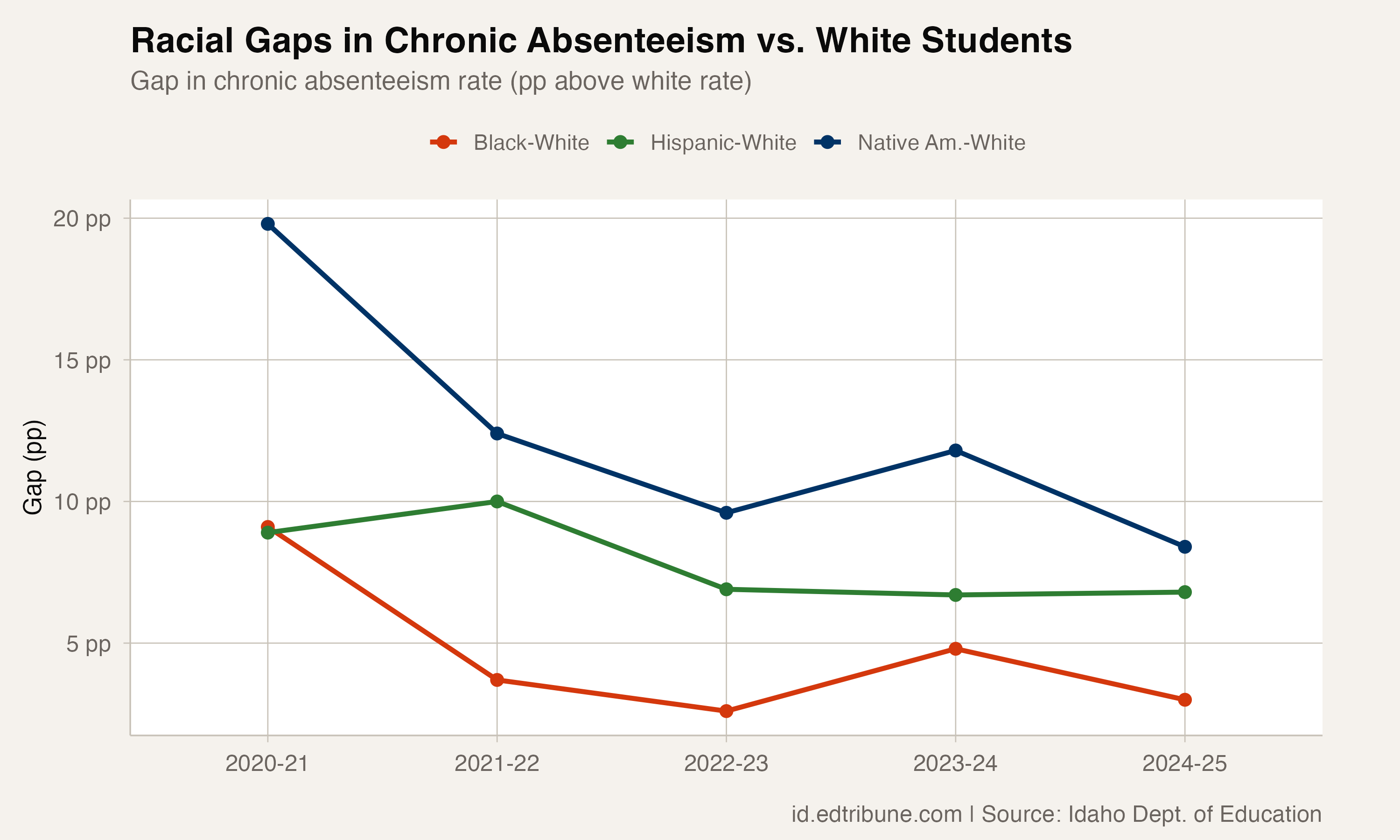
The contrast with Hispanic students is instructive. The Hispanic-white gap started at nearly the same level as the Black-white gap, 8.9 points in 2020-21, but has proven more resistant to closure. In 2024-25, Hispanic students face a 19.7% chronic rate versus 12.9% for white students, a 6.8-point gap. The narrowing from 8.9 to 6.8 points (2.1 points) is modest compared to the Black-white gap's 6.1-point compression.
The divergence likely reflects different underlying drivers. Idaho's Black population is concentrated in urban Boise-area schools with relatively robust attendance intervention programs. Hispanic students are spread across a wider geography including agricultural communities in the Treasure Valley and Magic Valley, where seasonal work patterns and limited bilingual outreach create attendance barriers that are structurally harder to address.
The Native American gap, meanwhile, narrowed even more dramatically, from 19.8 points to 8.4, though from a much higher starting rate (32.8% down to 21.3%). In proportional terms, the Black-white gap closure (from 9.1 to 3.0 points, a 67% reduction) outpaces even the Native American improvement.
Small numbers, real progress
Idaho's Black student population of 3,827 is small enough that a few hundred students' behavior can move the statewide rate by a full percentage point. This means the improvement should be read with some statistical caution. A cohort effect (a particularly disengaged group aging out) or a reporting change could produce apparent improvement without broad behavioral change.
But the improvement spans four straight years of data without reversing into a higher Black rate, which argues against a one-time statistical artifact. And a 15.9% chronic rate, while still above the white rate, is now close to the state average (14.6%) rather than far above it.
The 3.0-point gap that remains is small by Idaho's own recent history. It is not zero, and whether the gap continues to narrow or stabilizes at its current level will depend on whether the factors that drove the improvement, whatever they were, persist. Idaho's data does not illuminate the specific interventions or community changes that produced this shift, and the State Department of Education has not highlighted the Black-white gap closure in its public reporting.
Five years of state data show a two-thirds reduction in an equity gap that has drawn little public attention.
Detailed code that reproduces the analysis and figures in this article is available exclusively to EdTribune subscribers.
Discussion
Sign in to join the discussion.
Loading comments...