Correction (September 30, 2026): An earlier version said Oneida County District's 4.7% district-wide chronic absenteeism rate meant either that its other schools were extraordinarily well attended or that its data deserved scrutiny. Neither explains it. About 89% of the district's 8,610 students are enrolled in schools whose attendance counts the state does not publish school by school, chiefly Idaho Home Learning Academy, a home-learning charter school. Across the district's three schools that do publish counts, 42.6% of students were chronically absent. We rewrote that passage. The threshold chart now counts schools the same way the text does, including schools with fewer than 20 students. An earlier correction (April 16, 2026) made the historical threshold counts use a consistent "at or above" definition.
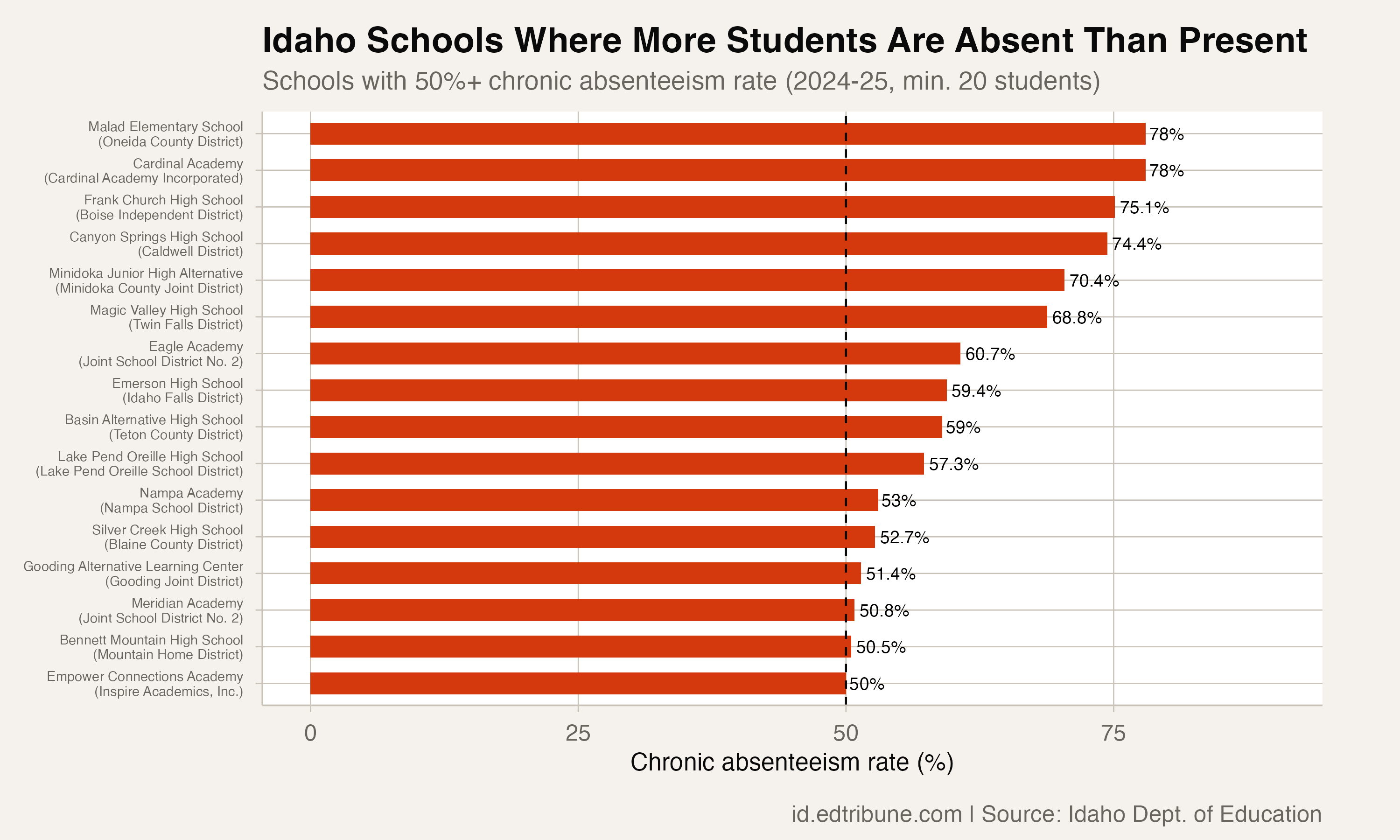
At Malad Elementary School in Oneida County, 78% of students are chronically absent, missing at least 10% of the school year. It is the highest rate of any school in Idaho, and it is not an alternative school. It is a 395-student elementary school in a small town in rural southeastern Idaho.
Malad Elementary shares the top spot with Cardinal Academy (also 78%, but a small charter with 41 students). Across Idaho, 16 schools have chronic absenteeism rates above 50%, meaning more students are habitually absent than not. Together, these schools serve 2,228 students where absence is the default condition.
The pattern: alternative schools, with exceptions
Most of the schools on this list are alternative high schools, designed specifically for students who have disengaged from traditional settings. Frank Church High School in Boise (75.1%, 374 students), Canyon Springs High School in Caldwell (74.4%, 180 students), and Magic Valley High School in Twin Falls (68.8%, 141 students) are all alternative programs where high chronic absence rates are, in some sense, expected. These schools exist precisely because their students were already struggling with attendance.
But Malad Elementary does not fit that pattern. It is a traditional elementary school with nearly 400 students, and its 78% chronic rate is anomalous.
Oneida County District as a whole reports a 4.7% chronic rate, one of the lowest in the state, but that figure says little about Malad's classrooms. About 89% of the district's 8,610 students are enrolled in schools whose attendance counts the state does not publish school by school, chiefly Idaho Home Learning Academy, a home-learning charter school. Those students count toward the district rate while adding almost nothing to its chronic count. Across the district's three schools that do publish counts, 399 of 936 students were chronically absent, a rate of 42.6%.
The trend is improving, slowly
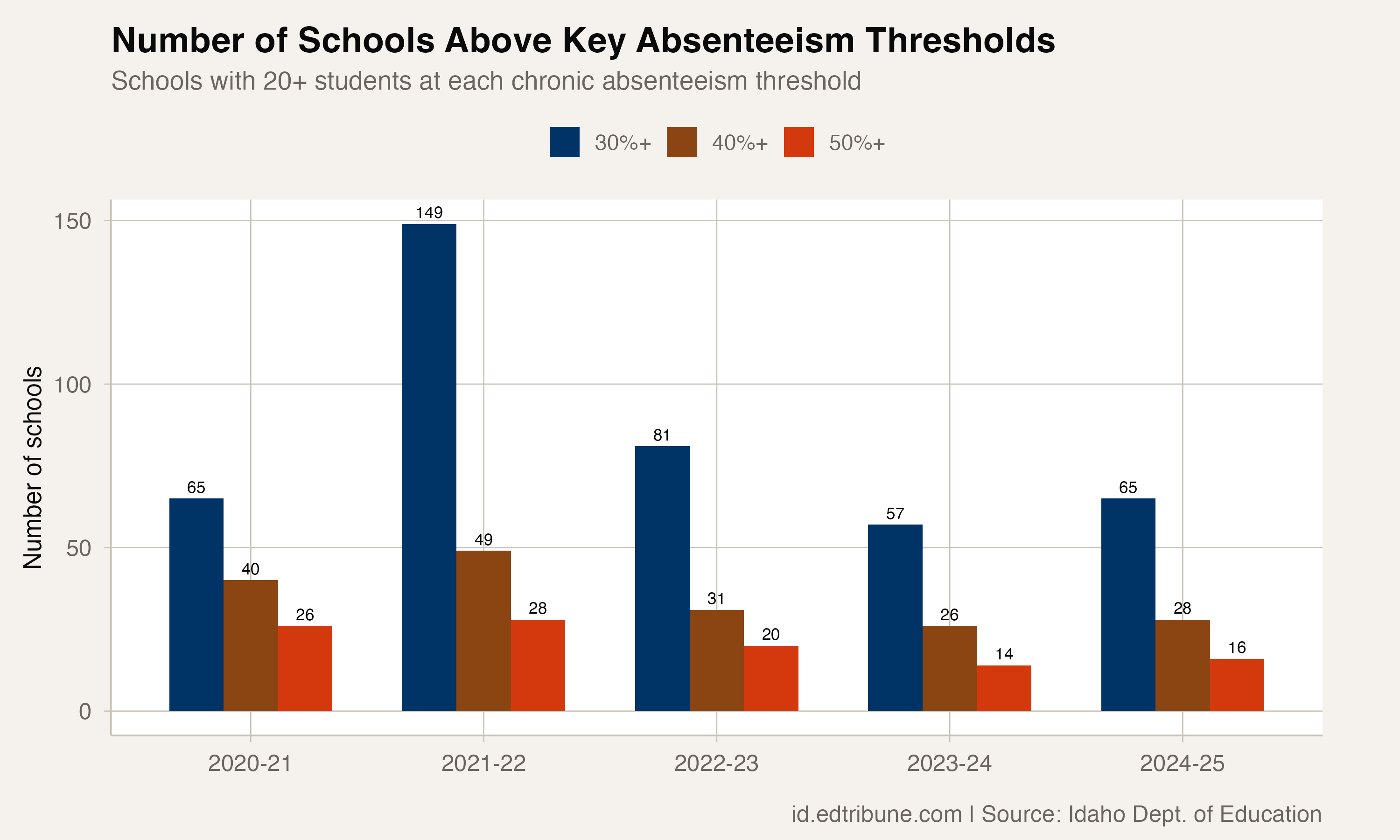
The number of majority-absent schools has declined from its peak. In 2021-22, at the height of the post-pandemic attendance crisis, 29 schools had rates at or above 50%. That number fell to 21 in 2022-23, then 15 in 2023-24, before ticking back up to 16 in 2024-25.
The broader picture is similar. Schools at or above 40% peaked at 50 in 2021-22 and now stand at 29. Schools at or above 30% peaked at 150 and now stand at 66. These are meaningful improvements, but they still leave dozens of schools with extreme attendance problems.
A systemic pattern in large districts
The 16 majority-absent schools are not concentrated in one corner of the state. They span districts from Boise to Coeur d'Alene to Twin Falls, and nearly every large Idaho district has at least one.
Joint School District No. 2↗ET (West Ada/Meridian), Idaho's largest, has two: Eagle Academy (60.7%) and Meridian Academy (50.8%). Boise Independent District has Frank Church High School (75.1%). Caldwell has Canyon Springs (74.4%). Idaho Falls has Emerson High School (59.4%). Mountain Home has Bennett Mountain High School (50.5%).
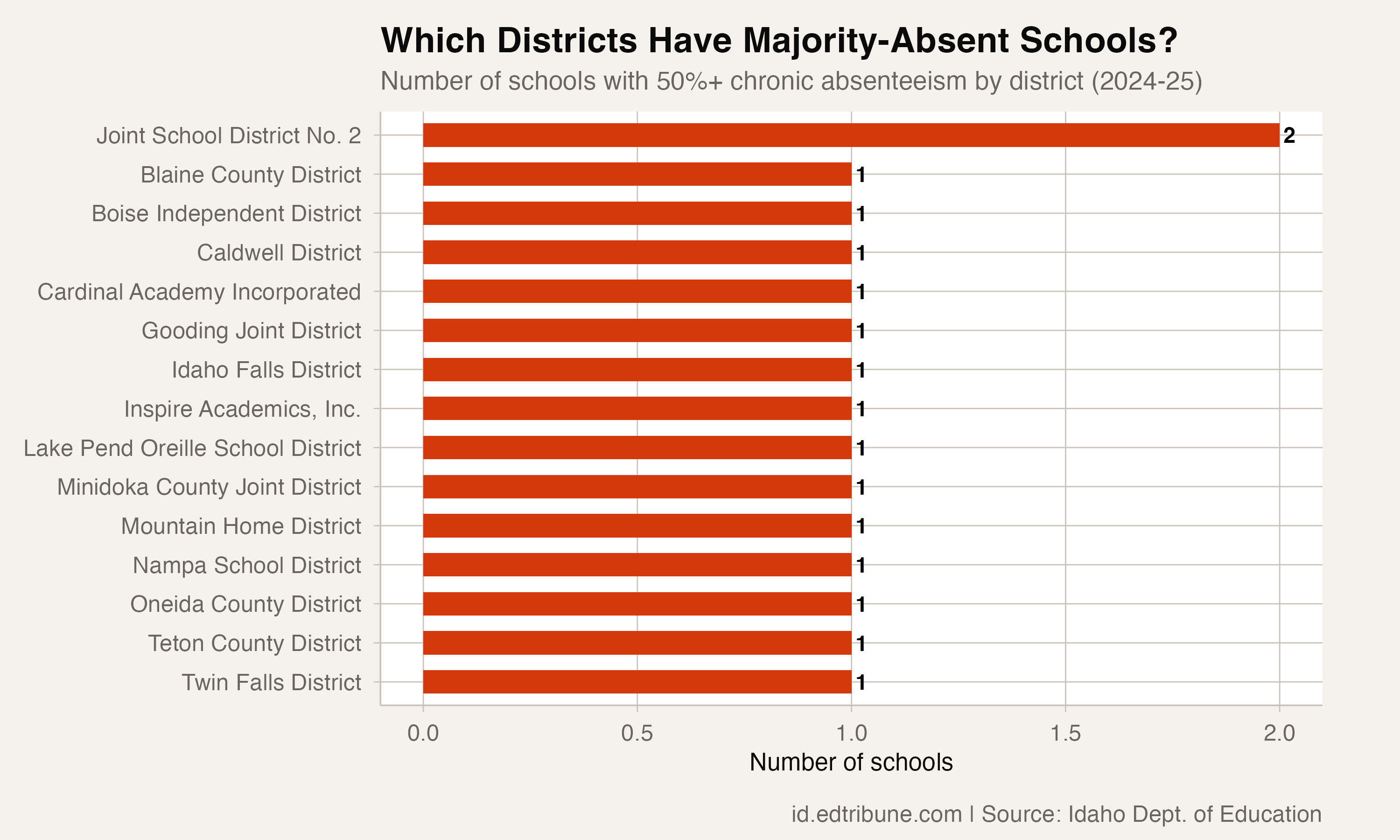
The concentration of these schools in alternative high school settings across nearly every major district suggests a structural challenge, not isolated failures. Idaho's alternative education system serves as the last safety net for disengaged students, but the attendance data shows that net is not catching many of them.
What majority-absent means for a school
A school where more students are chronically absent than regularly attending operates fundamentally differently from a normal school. Teachers cannot sequence lessons expecting consistent attendance. Group projects cannot assume students will be present. Peer relationships are fragmented. The school culture itself adapts to absence as the norm rather than the exception.
For alternative schools, this is partly by design: flexible scheduling, credit recovery, and individualized plans are meant to accommodate students who cannot or will not attend traditional schedules. But a 75.1% chronic rate at Frank Church or a 74.4% rate at Canyon Springs raises a harder question: whether these schools are meaningfully reaching their students at all, or whether they have become holding patterns for students who have already disengaged from public education entirely.
The 2,228 students across these 16 schools represent less than 1% of Idaho's total enrollment but a disproportionate share of the state's hardest-to-reach population. Whether the state's chronic absenteeism rate falls further may depend less on broad campaigns and more on what happens inside these specific buildings.
Detailed code that reproduces the analysis and figures in this article is available exclusively to EdTribune subscribers.
Discussion
Sign in to join the discussion.
Loading comments...