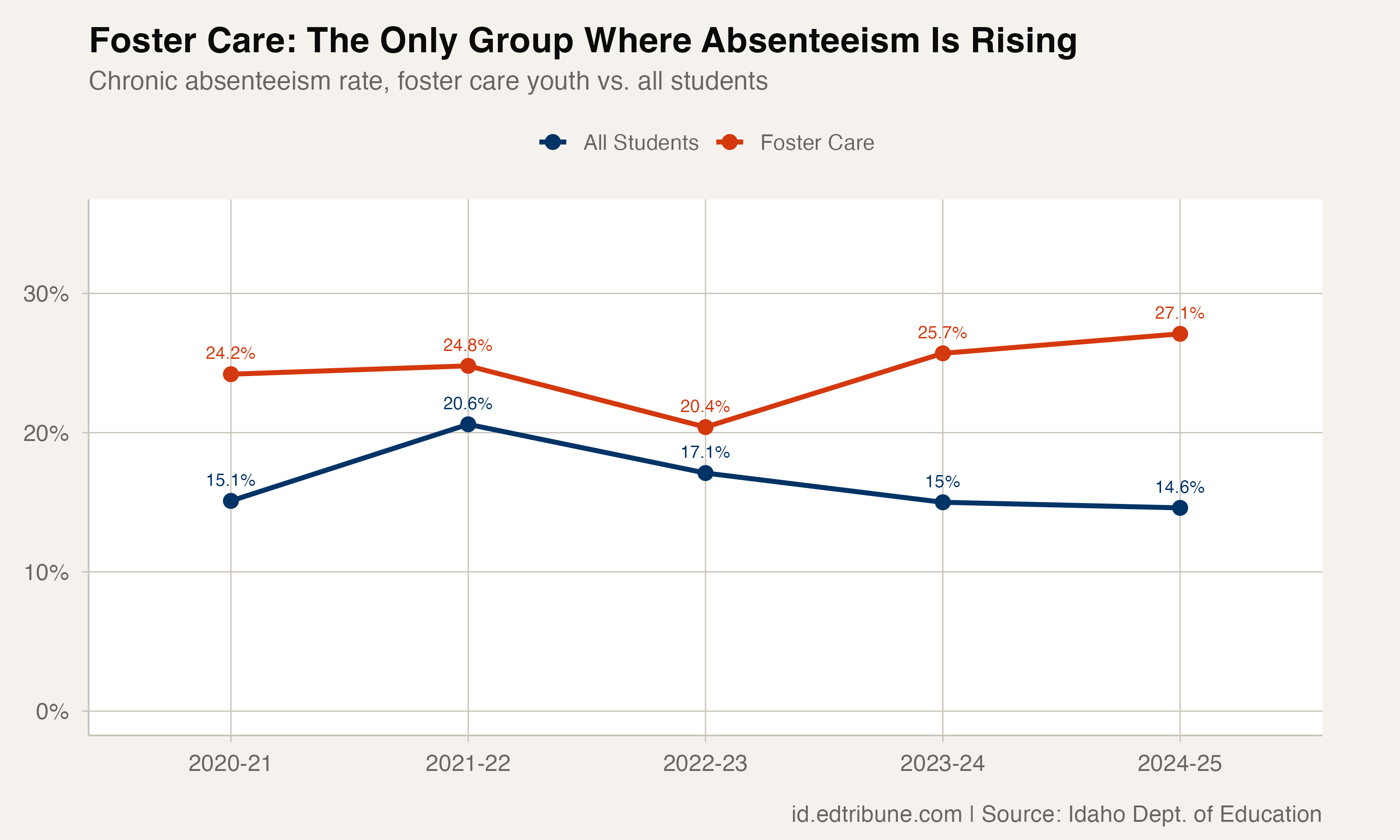
Every line on the chart trends downward, except one.
Students who are homeless improved. Migrant students improved. Economically disadvantaged, special education, English learners: all down from their starting points. The state average itself fell from 15.1% to 14.6% over four years of chronic absenteeism data.
Students in foster care climbed from 24.2% to 27.1%.
That 2.9 percentage point increase makes foster care the only student subgroup in Idaho where chronic absenteeism is not only failing to recover but actively worsening. More than one in four students in foster care in the state misses at least 10% of the school year, and the trend is headed in the wrong direction.
The instability problem
The relationship between foster care and school attendance is not a mystery. A child who changes placements mid-semester loses days in transit. A child placed in a home across town may lose their bus route. A child cycling through emergency placements may attend three schools in a year and settle at none.
Idaho's foster care system has been under strain. The 2024 Legislature approved a $14 million emergency supplemental appropriation to stabilize the child welfare system, and in March 2026, lawmakers enacted a foster-child safety rights law aimed in part at educational stability. The Children and Family Services division within the Department of Health and Welfare has acknowledged placement shortages that force some children into placements far from their schools.
A volatile denominator
One important caveat: the foster care enrollment counts in Idaho's absence data are volatile. The number of students in foster care tracked in the system swung from 1,089 in 2020-21 to just 584 in 2021-22, back up to 705 in 2022-23, then 937 and 817 in the most recent two years. These swings, an 87% increase from the low to the next year, are larger than actual foster care caseload changes and likely reflect inconsistencies in how districts identify and report foster care status.
That volatility means the rate itself is less stable than for larger populations. A shift of just 23 students between "chronically absent" and "regularly attending" would move the rate by roughly a full percentage point. The worsening trend from 24.2% to 27.1% should be read with this statistical caution in mind, though the direction (upward, while everything else moves down) is consistent across multiple years.
How foster care compares to other vulnerable groups
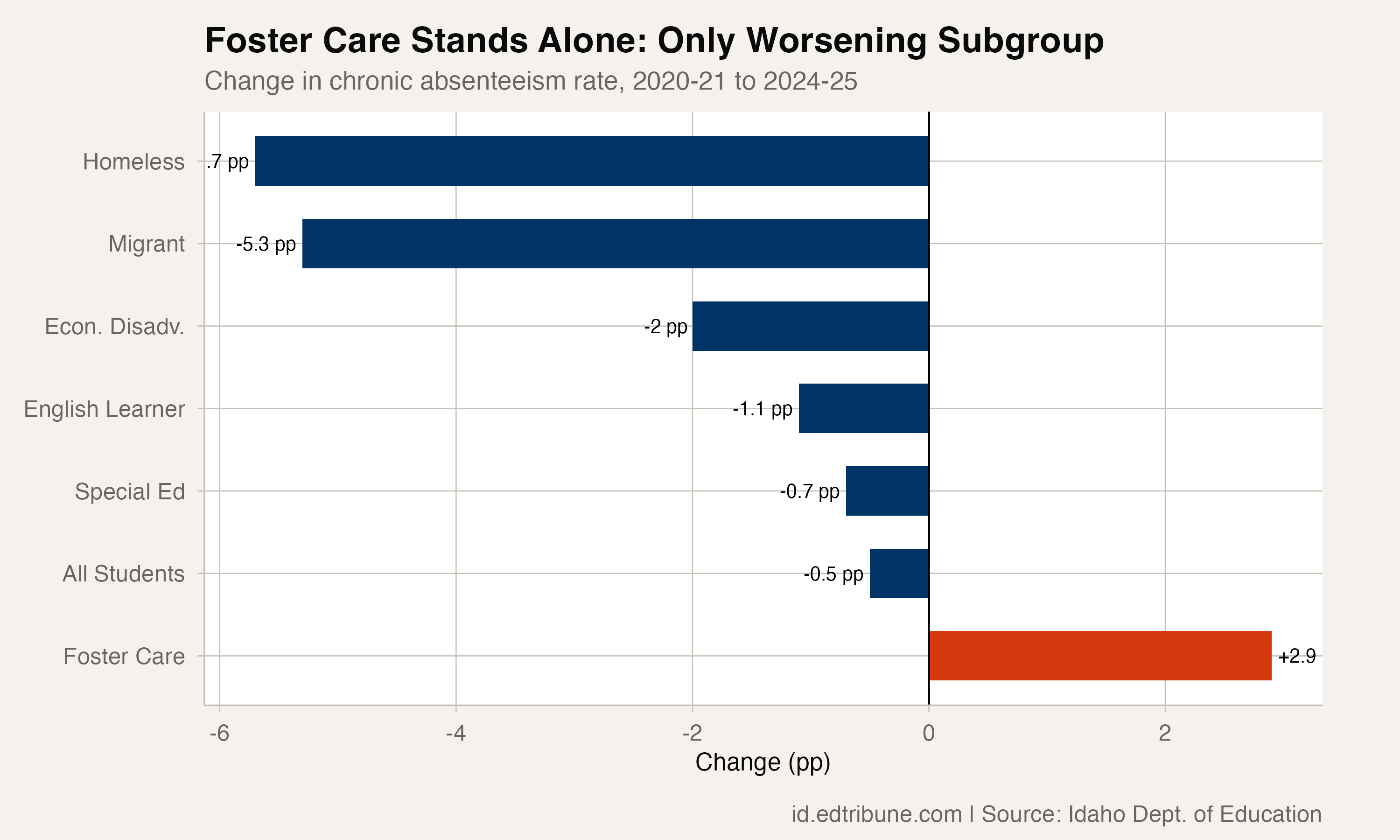
The contrast is sharp. Students who are homeless, who face many of the same housing-instability barriers as students in foster care, improved by 5.7 percentage points, from 36.3% to 30.6%. Migrant students dropped 5.3 points. Economically disadvantaged students fell 2.0 points.
The divergence raises a pointed question: if students experiencing homelessness, arguably an equally disruptive condition, can improve their attendance rates, why can't the system produce the same results for the roughly 800 students in state custody?
Part of the answer may lie in the nature of the interventions. Services for students who are homeless under McKinney-Vento are federally mandated and include transportation guarantees, automatic enrollment, and designated liaisons in every district. Students in foster care theoretically have similar protections under the Every Student Succeeds Act, but implementation depends on coordination between child welfare agencies and school districts, a handoff that frequently breaks down.
What 27.1% means in practice
With 817 students in foster care tracked in the 2024-25 data, a 27.1% chronic rate translates to roughly 221 students missing at least 18 days of school. For a population already facing disrupted home lives, disrupted schooling compounds the instability.
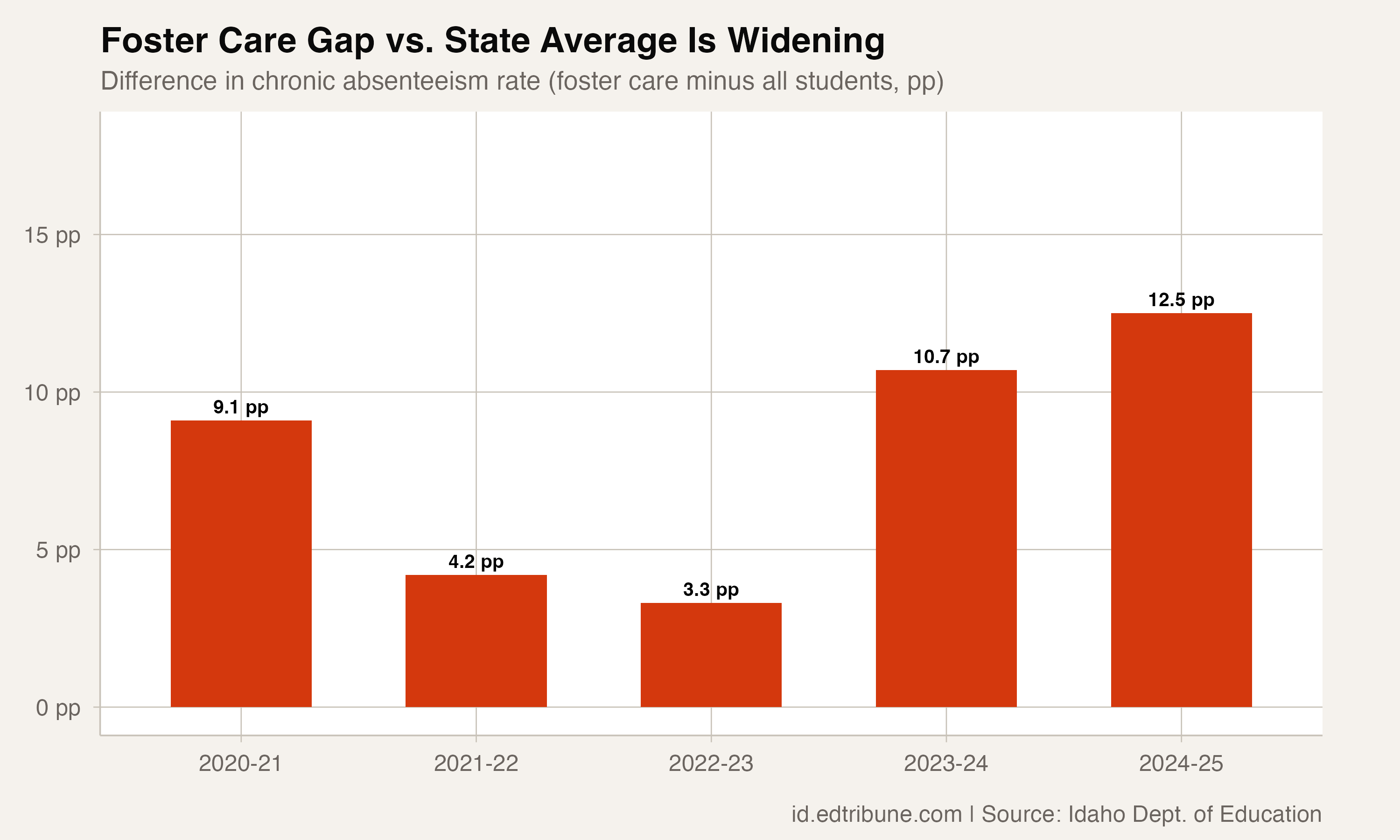
The gap between students in foster care and the state average has widened from 9.1 percentage points in 2020-21 to 12.5 points in 2024-25. While other equity gaps in Idaho's absence data have narrowed (the Native American-state gap shrank by 11 points, the Black-state gap by 5.7 points), the foster care gap is moving in the opposite direction.
Idaho's new foster-child safety rights law may address some of the structural barriers. Whether it reaches the 221 students currently falling through the cracks will depend on implementation at the district level, where the handoff between caseworkers and attendance officers remains the weakest link.
Detailed code that reproduces the analysis and figures in this article is available exclusively to EdTribune subscribers.
Discussion
Sign in to join the discussion.
Loading comments...