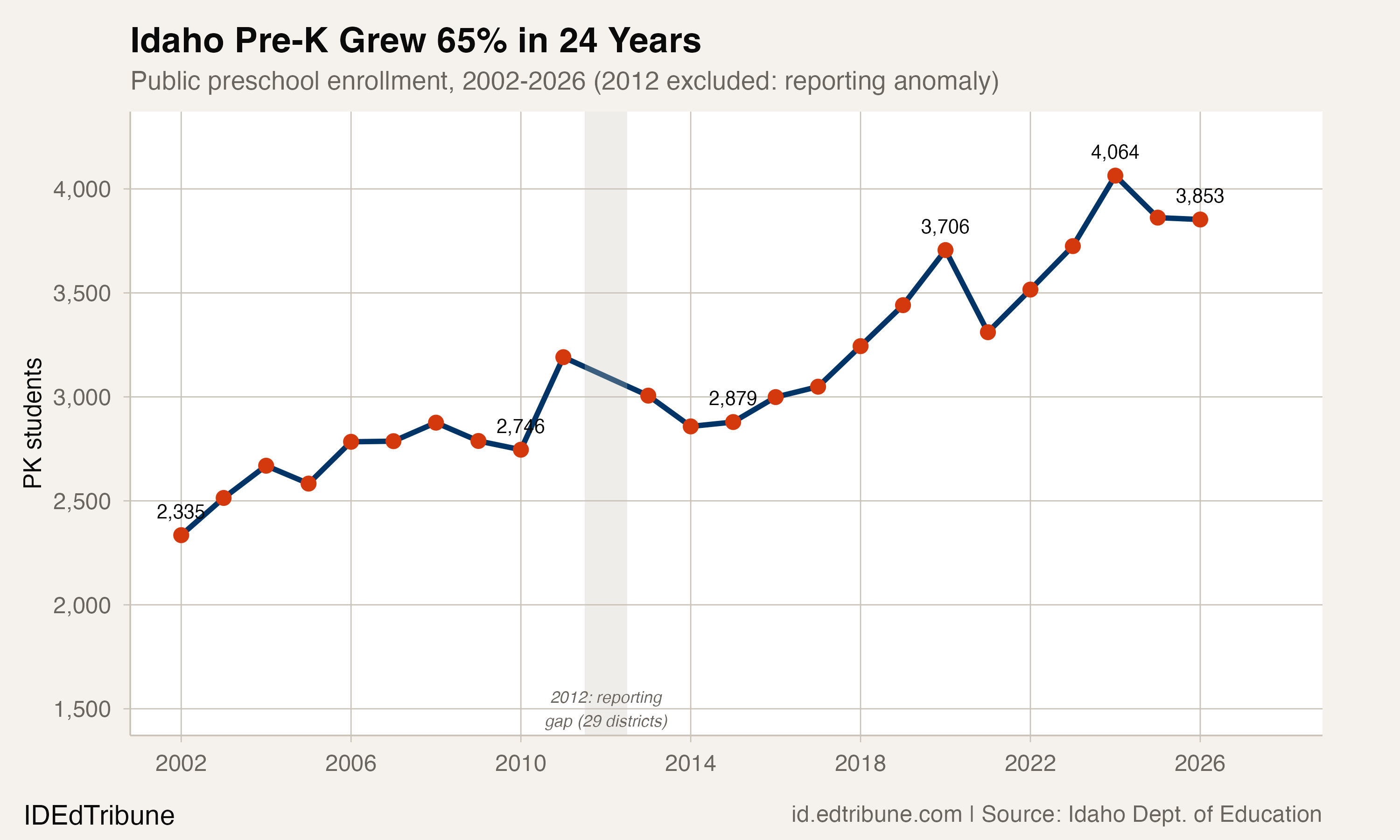
Idaho does not fund public preschool. It is one of just six states that contribute zero state dollars to pre-K education, and its Legislature has repeatedly blocked federal grants that would have seeded new programs. Yet 3,853 children sat in public school preschool classrooms in 2025-26, a 65.0% increase from the 2,335 enrolled in 2001-02. That growth rate, a compound annual gain of 2.11%, is the fastest of any grade level in the state.
The expansion happened anyway. One hundred districts now report PK students, up from 78 in 2002. The PK-to-kindergarten ratio, a rough measure of how many children access a public preschool year before entering the K-12 pipeline, rose from 13.1% to 19.1%. For every five children entering kindergarten in Idaho, nearly one already appeared on a public school roster the year before.
The fastest-growing grade in a growing state
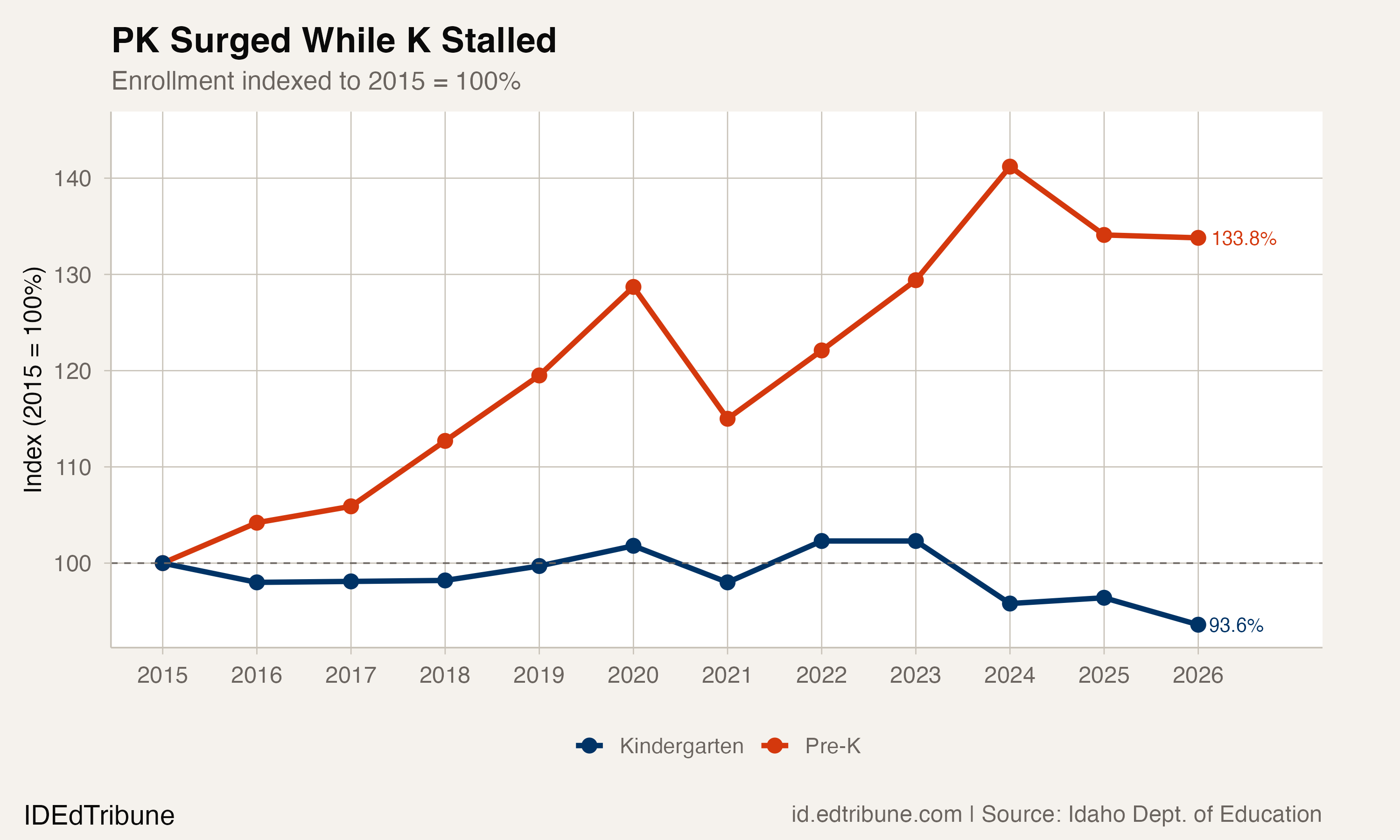
Idaho's total public school enrollment rose 27.6% over the same 24-year span, from 246,184 to 314,097 students. Kindergarten, the traditional entry point, grew just 13.1%. Grade 12 grew 43.7%. Pre-K, at 65.0%, outpaced every other grade level by a wide margin.
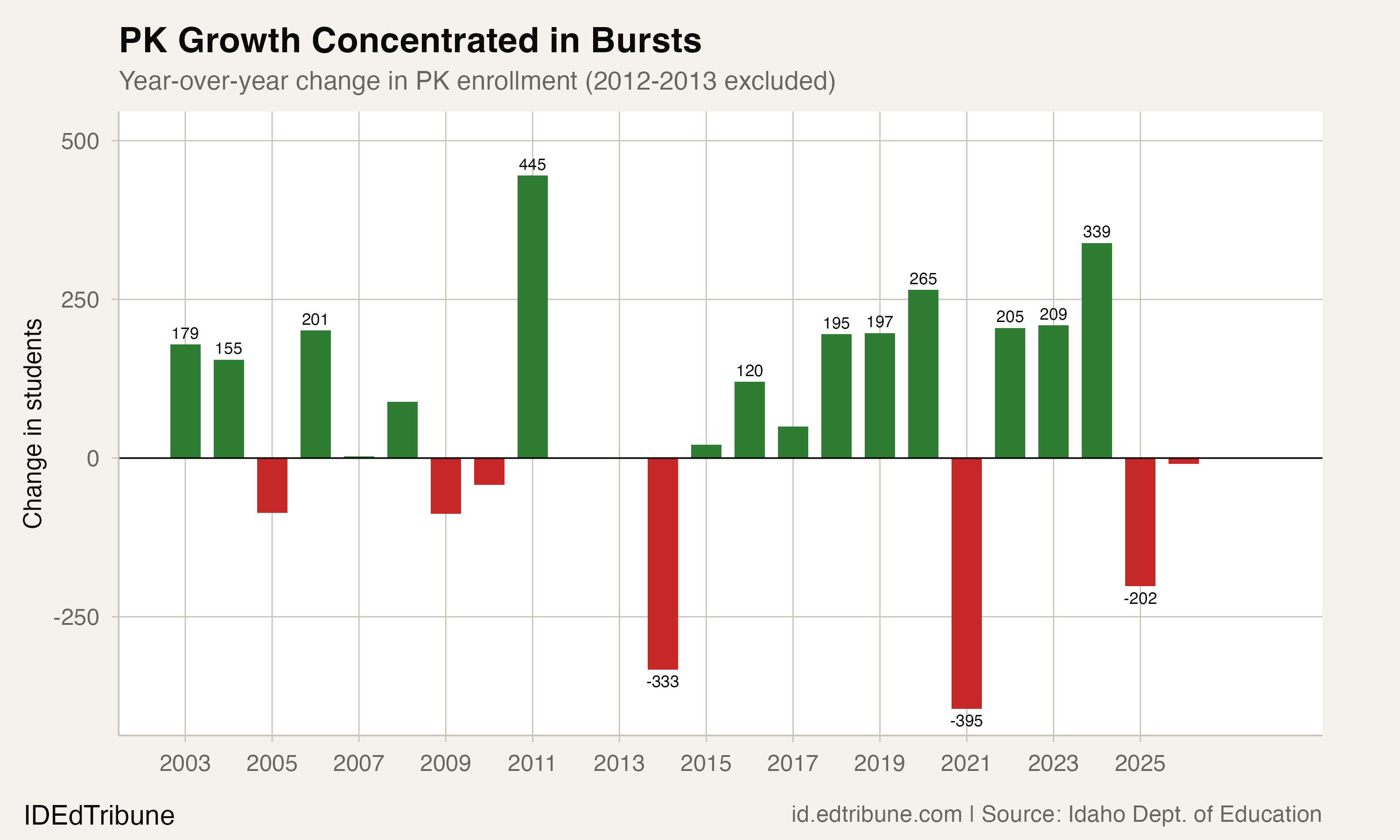
The acceleration was sharpest after 2015. Between 2014-15 and 2023-24, PK enrollment surged 41.2%, from 2,879 to a peak of 4,064. Total enrollment grew 7.9% over that same window. PK did not merely keep pace with population growth. It grew five times faster.
That peak in 2024 was followed by a modest pullback: 3,862 in 2025 and 3,853 in 2026. The two-year dip, totaling 211 students, has not erased the post-2015 gains but does suggest the expansion may have reached a plateau under the current funding model.
Where the growth is concentrated
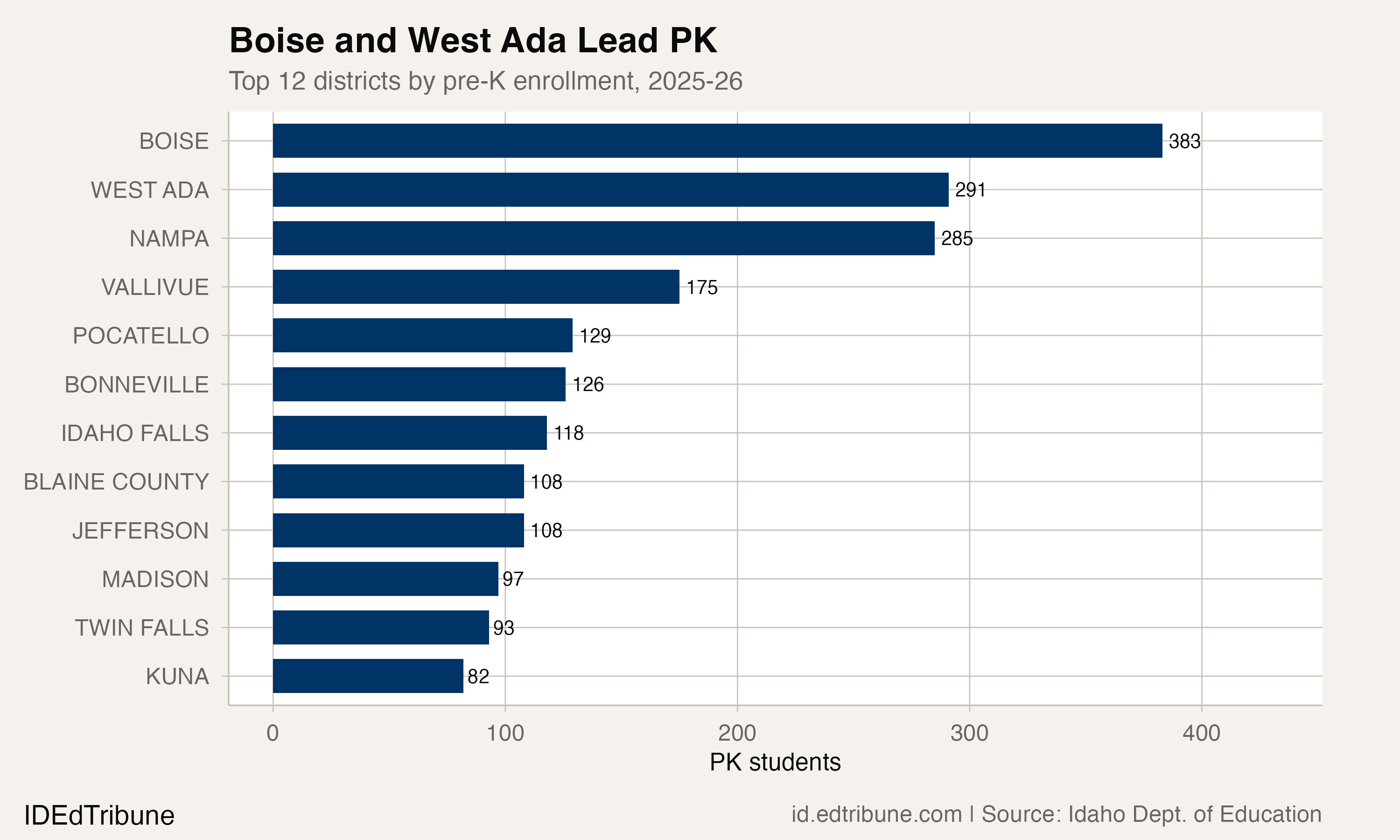
Idaho's PK expansion is not evenly distributed. The top five districts, Boise (383 students), West Ada (291), Nampa (285), Vallivue (175), and Pocatello (129), account for 32.8% of all public PK enrollment. Just 22 districts enroll 50 or more PK students. The remaining 78 districts with PK programs serve a median of 17 students each.
The Treasure Valley drove much of the post-2015 surge. Nampa more than doubled its PK program from 113 students in 2015 to 285 in 2026, a 152.2% increase. Vallivue grew from 71 to 175, up 146.5%. Boise added 159 PK seats over the same period, a 71.0% increase.
Not every large district followed the same trajectory. Coeur d'Alene cut its PK program from 106 students in 2015 to 64 in 2026, a 39.6% decline. Idaho Falls shrank from 151 to 118, down 21.9%. These are not small districts. They represent deliberate local decisions to scale back, even as peers in the Boise metro expanded.
No charter, no state. So who pays?
Zero charter schools in Idaho report any PK enrollment, across all 25 years of data. Every one of the 3,853 PK students in 2025-26 is in a traditional district program.
That absence points to the funding mechanism. Because Idaho provides no state per-pupil dollars for pre-K, districts that offer it must find other money. The primary source is federal IDEA Part B, Section 619, which funds preschool services for children ages 3-5 with disabilities. Idaho flows 100% of its IDEA preschool allocation to local districts. The practical effect is that most public PK in Idaho is "developmental preschool," serving children who qualify for special education services, with a smaller number of general-education seats funded through local levies, grants, or fees.
This explains why the PK-to-K ratio has a ceiling. Without state or charter investment, growth depends on individual district decisions, federal special education allocations, and private philanthropy. The Blue Cross of Idaho Foundation for Health recently awarded $50,000 grants to 11 districts to launch or expand early childhood programs, with another 24 districts expressing interest. The Idaho Association for the Education of Young Children now operates 21 early learning collaboratives statewide, up from 15 when the model launched in 2019. Each collaborative stitches together local partnerships between districts, childcare providers, and businesses to deliver free school-readiness programs.
The Legislature's role: blocking, not building
The expansion happened despite active legislative resistance. In 2021, House Republicans killed a bill that would have accepted $6 million in annual federal Preschool Development Grant funding. Some members argued the state should not encourage mothers to enter the workforce. The State Department of Education subsequently did not apply for $241 million in federal preschool development grants distributed to 43 other states, because the Legislature had not authorized the department to spend money on pre-K.
"The (Preschool Development Grant) renewal was really helping build that plane before it took off." -- Beth Oppenheimer, Idaho AEYC, Idaho EdNews, 2023
The consequence was direct. Collaboratives that had been planning expansions with federal seed money were forced to scale back or shift to "pay what you can" models when the grants evaporated. Idaho's neighbor Montana received $4.2 million from the same federal pot.
The 2012 data gap
One year in the dataset demands a caveat. In 2011-12, PK enrollment collapsed from 3,191 to 1,007. The cause was not a real decline: 59 districts that reported PK students the year before simply stopped reporting them. Only 29 districts reported any PK enrollment that year, compared to 86 in the prior year and 95 the year after. This is almost certainly a reporting or classification change at the state level, not an actual disappearance of 2,184 preschoolers. All trend comparisons in this article exclude 2012.
Approaching a threshold
The PK-to-K ratio touched 19.7% in 2024, just below the one-in-five mark. It settled back to 19.1% in 2026, partly because PK dipped slightly and partly because kindergarten also contracted (from 22,042 in 2023 to 20,184 in 2026, an 8.4% decline).
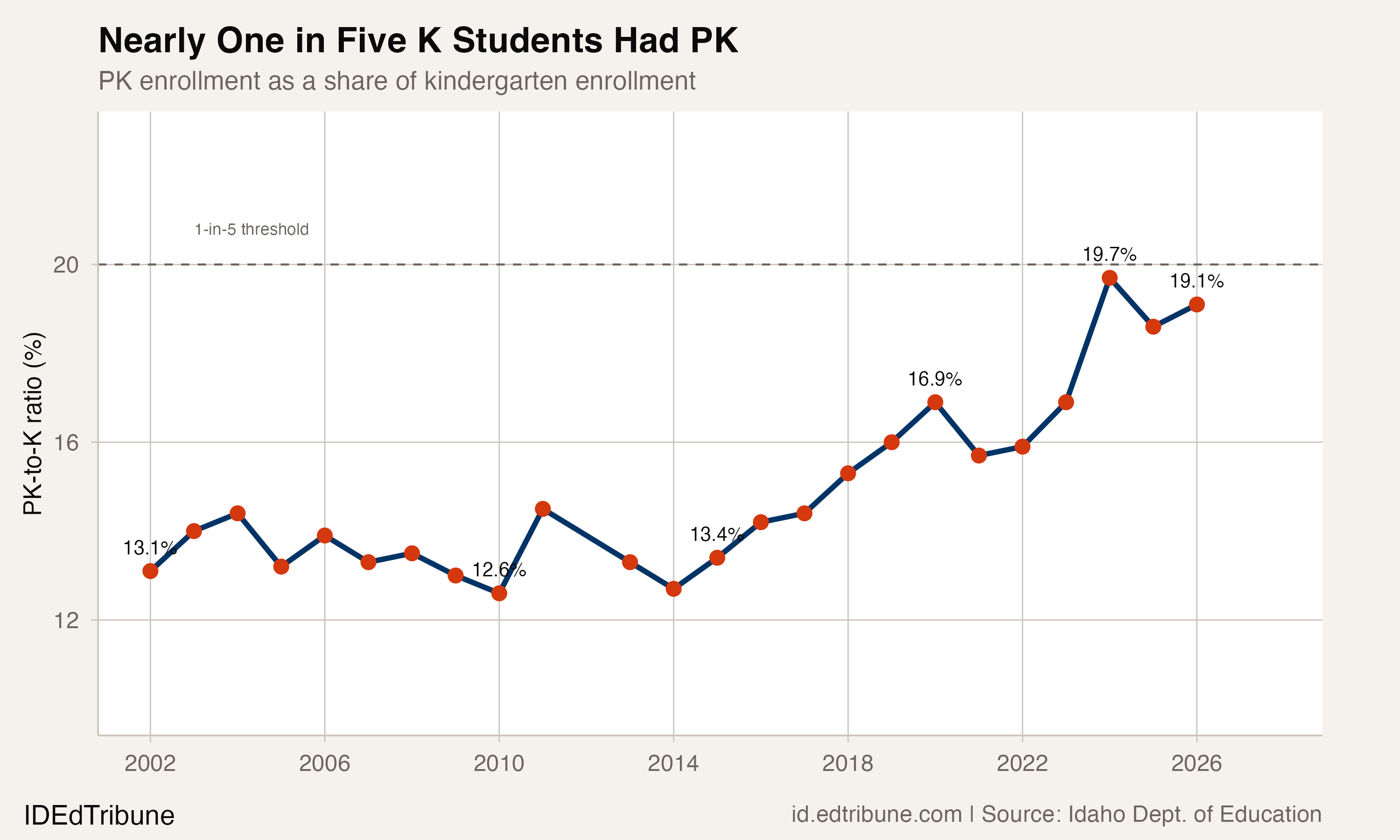
Twenty-four districts attended the Blue Cross Foundation's webinar series on early education expansion. Twenty-one early learning collaboratives now operate statewide, up from 15 in 2019. The demand side is visible. The supply side runs on IDEA special education dollars, local levy decisions, and $50,000 philanthropy grants, a patchwork that has produced 3,853 PK seats in a state with roughly 20,000 kindergartners.
Idaho is one of six states that contribute zero dollars to pre-K. It is the only one where the Legislature has actively blocked available federal grants. The 65% growth happened anyway, one district budget decision at a time.
Detailed code that reproduces the analysis and figures in this article is available exclusively to EdTribune subscribers.
Discussion
Sign in to join the discussion.
Loading comments...