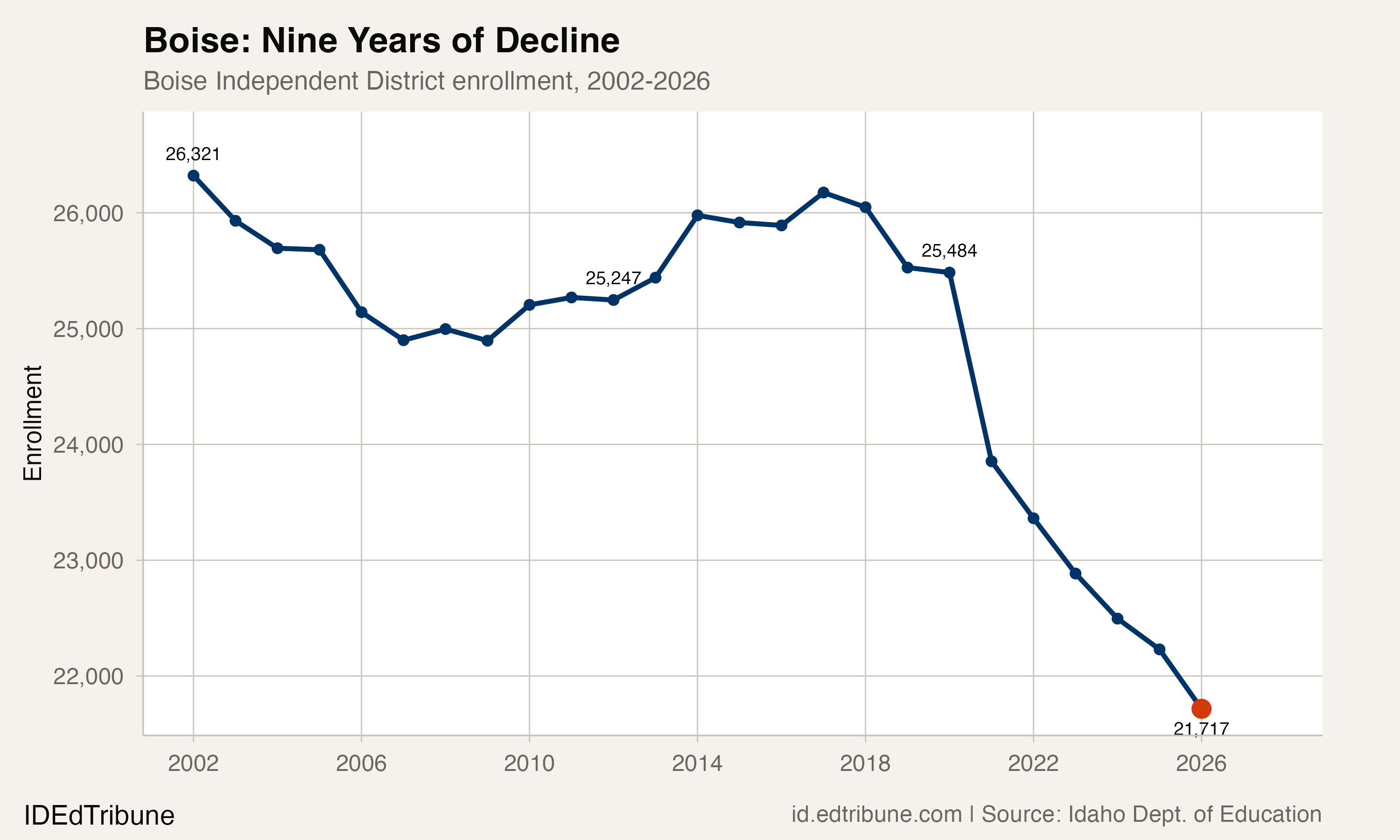
Vallivue School District↗ET enrolled 10,700 students in fall 2025, an all-time high. Twenty miles east, Boise Independent District↗ET enrolled 21,717, an all-time low. The two districts sit in the same metro area, draw from the same labor market, and compete for the same families. One has grown 175.2% since 2002. The other has lost 4,604 students, 17.5% of its peak enrollment, and has not grown in nine years.
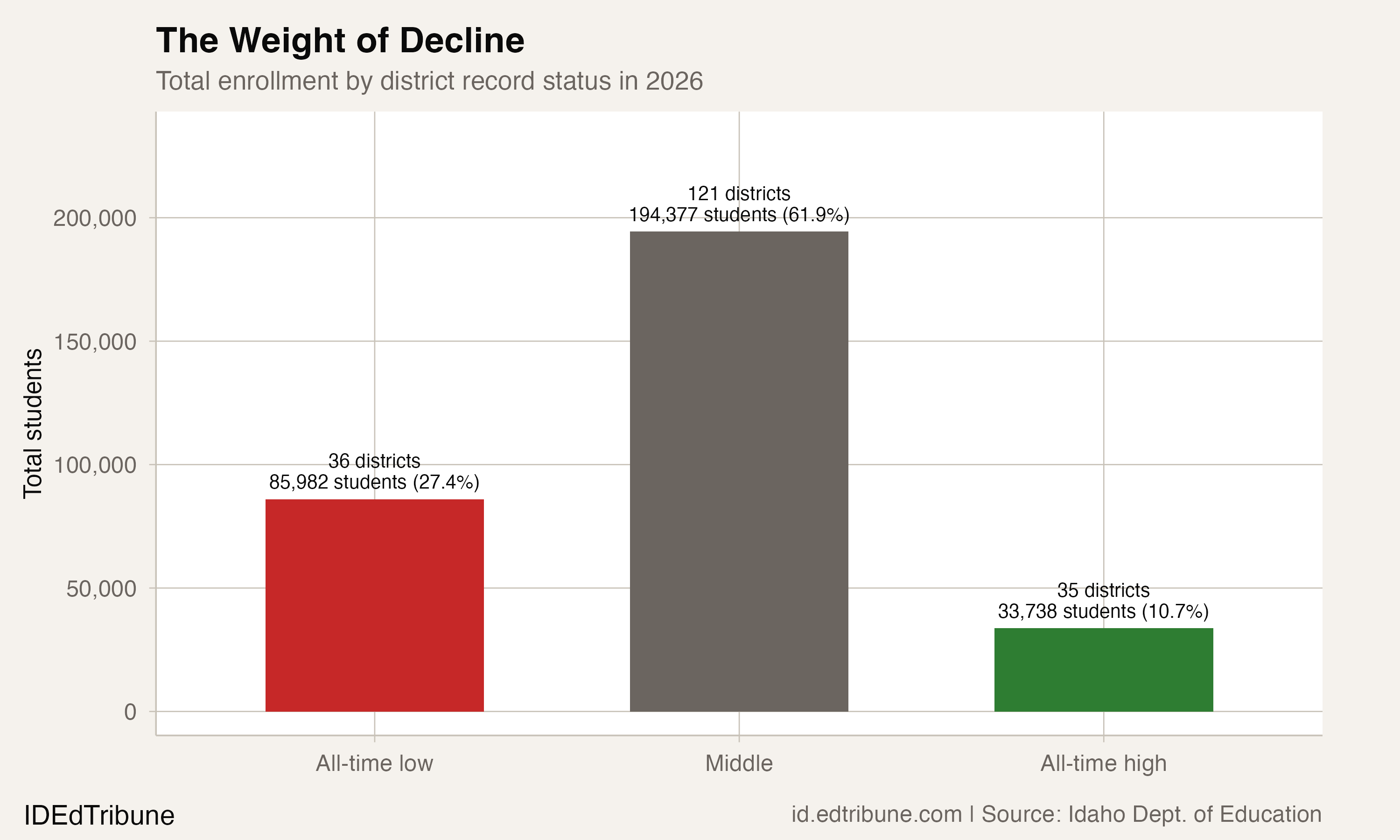
This is the Idaho enrollment story in miniature. Statewide, 35 districts hit record-high enrollment in 2025-26 while 38 hit record lows. The numbers are almost balanced. The weight is not: the 38 districts at all-time lows collectively serve 86,114 students, 27.4% of the state's enrollment. The 35 at all-time highs serve just 33,738, or 10.7%.
The lopsided split
Idaho added 72,795 students between 2002 and its 2023 peak of 318,979, a 29.6% increase in two decades. That growth has evaporated. The state lost 4,882 students over the past three years, including 3,970 in 2025-26 alone, the largest single-year decline in at least 25 years of data.
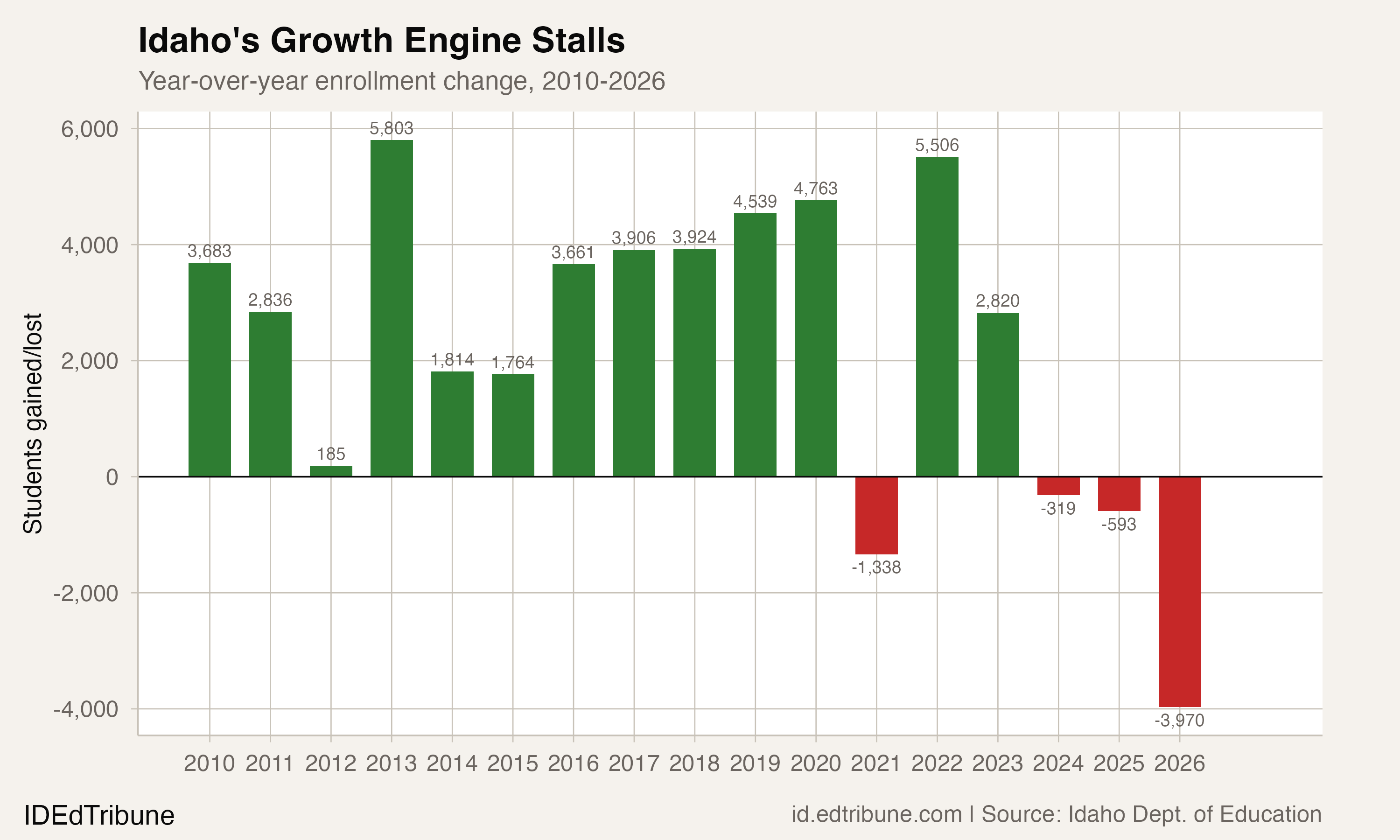
Of 190 districts with enrollment in both 2024-25 and 2025-26, 125 declined, 60 grew, and five were flat. The losses are concentrated at the top: West Ada, the state's largest district, lost 538 students. Boise lost 513. Nampa lost 256. Twin Falls lost 250. Eight of the state's 10 largest traditional districts shrank.
The districts at record highs, meanwhile, are small. Their median enrollment is 492 students. Only two, Vallivue and Middleton, exceed 4,000.
Who is growing, and how
Of the 35 districts at all-time highs, 31 are charter schools, virtual academies, or charter-like entities. Four are traditional districts: Vallivue (10,700), Middleton↗ET (4,401), Boundary County↗ET (1,697), and Avery (32).
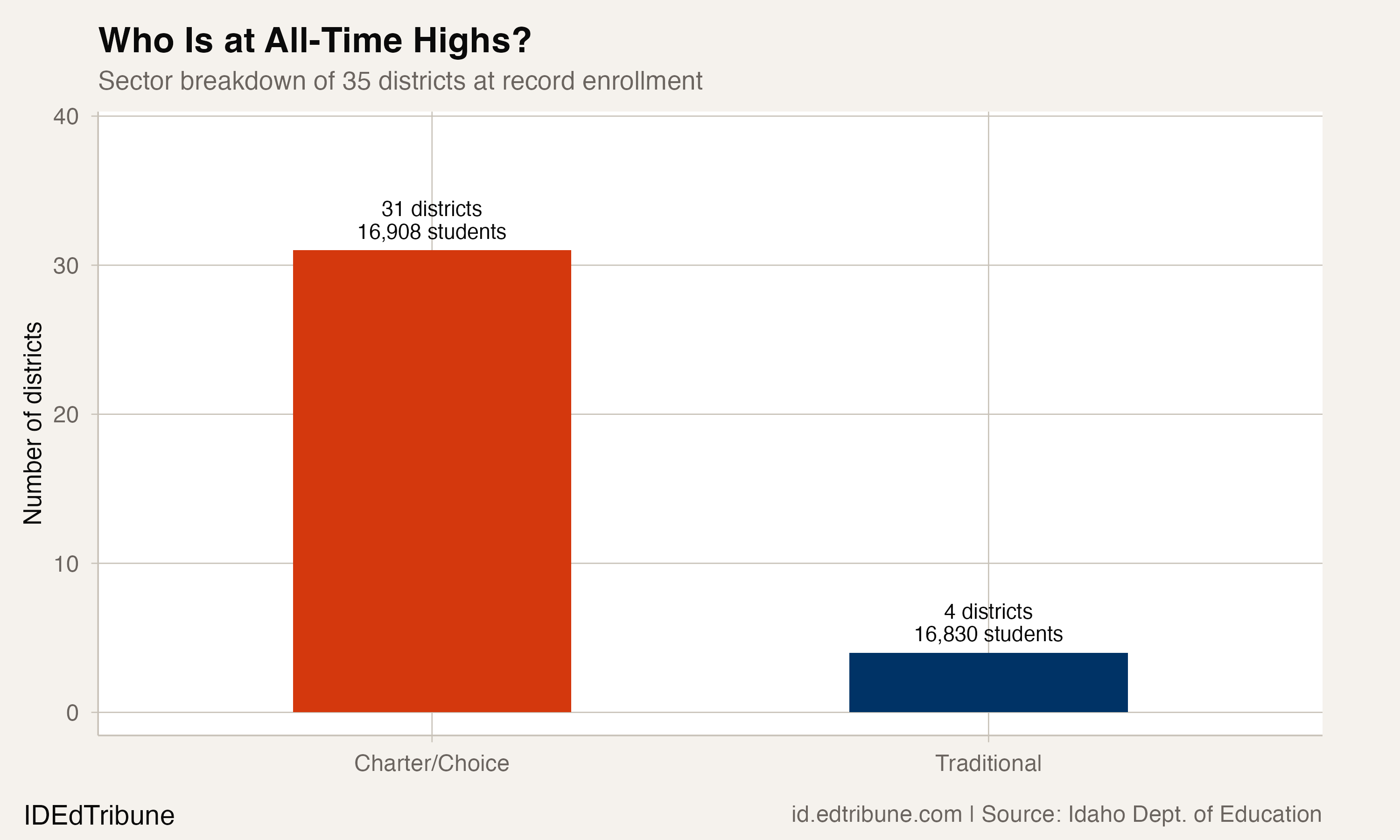
The charter/choice category includes a range of models. Idaho Arts Charter (1,421), Compas Public Charter (1,289), and North Star Charter (1,143) are brick-and-mortar schools. iSucceed Virtual High School (1,785) and Idaho Virtual High School (833) are fully online. The seven Gem Prep campuses, which collectively enroll 3,240 students across the state, are listed as traditional districts by the state but operate as a charter network.
The demand for alternatives remains unmet. At least 10,711 students sat on charter school waitlists at the start of the 2025-26 school year, and federal funding is supporting the addition of 13 more charter schools and 5,900 seats by 2028.
The biggest districts are the ones shrinking
The concentration of record lows among Idaho's biggest districts is the most consequential pattern in these numbers. Boise↗ET, Pocatello↗ET (11,437), and Idaho Falls↗ET (9,751), the state's second, fifth, and seventh largest districts, are all at their lowest enrollment in at least 25 years.
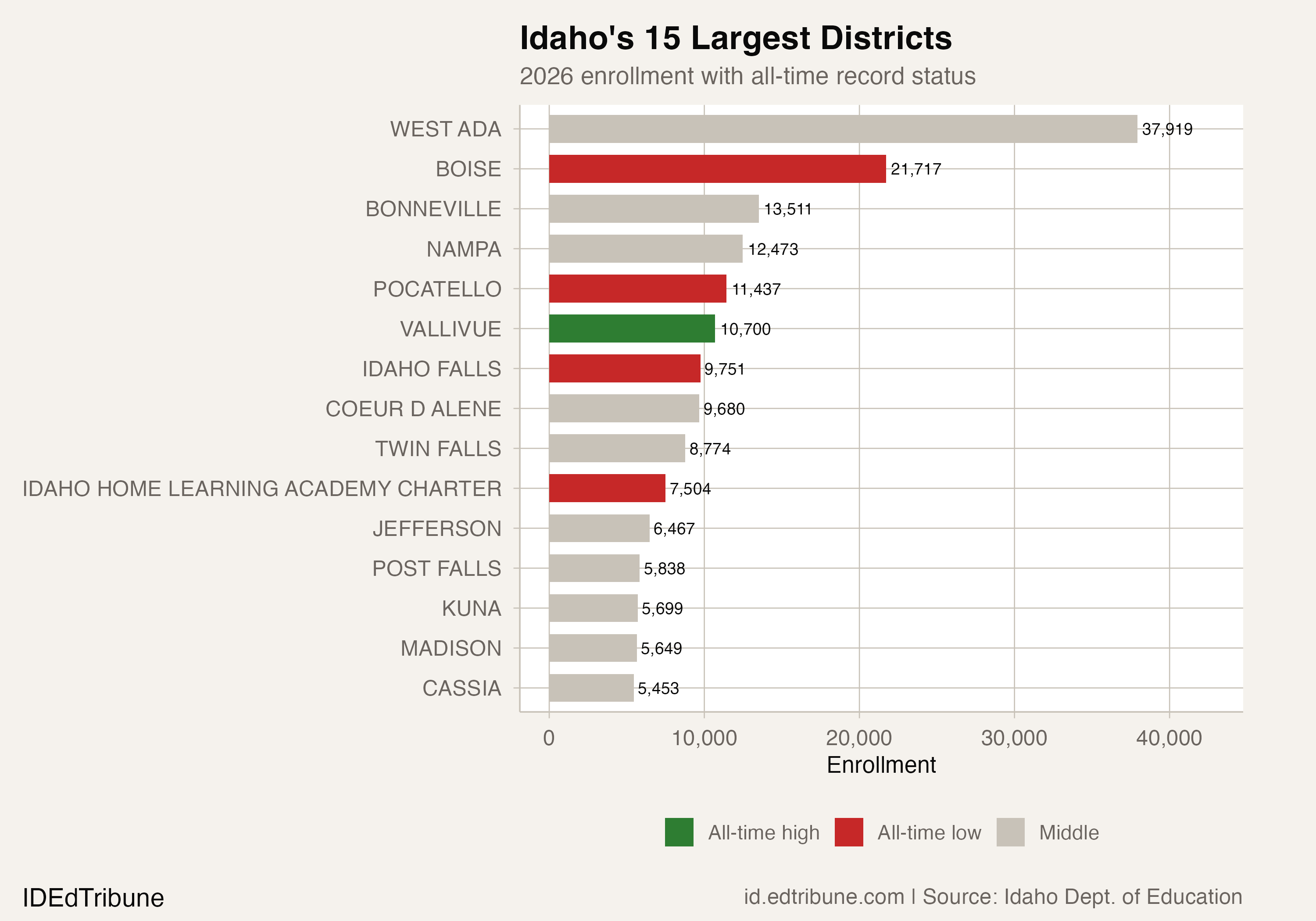
Boise's decline is the longest and deepest. The district peaked at 26,321 students in 2002, the first year in the dataset, meaning its actual peak may have been higher. It has declined in nine consecutive years, losing 4,458 students since 2017, a 17.0% drop. Average daily attendance last year fell to 20,317, the lowest since the 1983-84 school year.
A demographic mismatch Idaho cannot build its way out of
Idaho was the fastest-growing state in the country between 2012 and 2022. But the growth skews old. Between 2020 and 2024, youth contributed only 9.3% of total population growth, the smallest share of any age category, while adults 65 and older accounted for the largest share at 17.4% growth.
The mechanism is straightforward. Many of Idaho's new residents are retirees fleeing higher-cost states, drawn by lower taxes and housing that, while expensive by Idaho standards, remains cheaper than coastal markets. Labor economist Sam Wolkenhauer put it starkly: "In Idaho, there are 68% as many infants as there are 18 year olds." Each graduating class is larger than the kindergarten cohort replacing it. In 2026, Idaho enrolled 25,316 twelfth graders and 20,184 kindergartners, a gap of 5,132 students that has widened every year since 2018.
Housing costs compound the problem inside the Boise metro. Rising prices in Ada County have been pricing young families into Canyon County suburbs like Vallivue and Middleton, or out of the metro entirely. Nampa, once a more affordable alternative, has itself begun losing students, shedding 256 in 2025-26 and repurposing four elementary schools for other uses.
Rural districts on a longer clock
Twenty-nine of the 38 districts at all-time lows have full 25-year histories in the data, making their declines not statistical artifacts of short timelines but confirmed long-term trends. These 29 districts have lost an average of 26.7% from their peak enrollment.
Salmon District↗ET, in the Lemhi Valley, enrolled 1,143 students in 2002 and 609 in 2026, a 46.7% decline over 24 years. Caldwell↗ET peaked at 6,428 in 2008 and has since lost 1,496 students, 23.3% of its enrollment. Soda Springs, Marsh Valley, Payette, St. Maries: the list of small and mid-size districts that have never been smaller runs the length of Idaho's rural geography.
These districts face a structural challenge distinct from Boise's housing-driven losses. Idaho's population grew 45% between 2002 and 2022, but births increased only 7% over the same period. The birth rate fell from 16.6 per 1,000 in 2007 to 11.8 in 2021, a 29% decline. For rural districts already operating on thin margins, Idaho's ranking of 49th or 50th nationally in per-pupil funding since 2020 leaves little room to absorb the losses.
In the past six months alone, at least seven Idaho school districts have announced or considered school closures, including Caldwell, Coeur d'Alene, Boise, and Marsh Valley, four of which appear on the all-time-low list.
The acceleration underneath
The near-symmetry of 35 record highs and 38 record lows obscures an acceleration. In 2023, 15 districts hit record highs and six hit record lows. In 2025, those numbers were 23 and 14. In 2026: 35 and 38. The split is widening in both directions simultaneously.
Seven districts have announced or considered school closures in the past six months alone. Nampa shuttered four buildings. Caldwell, Coeur d'Alene, Boise, and Marsh Valley are all weighing cuts. On the other side, Vallivue's two new elementary schools opened in August, and Gem Prep broke ground on an eighth campus in Idaho Falls.
The 121 districts in the middle, 61.9% of statewide enrollment, are the pool from which future records will be drawn. Most of them lost students in 2025-26. The new residents keep coming. Their children, increasingly, do not.
Detailed code that reproduces the analysis and figures in this article is available exclusively to EdTribune subscribers.
Discussion
Sign in to join the discussion.
Loading comments...