Idaho's charter sector enrolls 22,974 students in 2025-26, up 34-fold from the 674 who attended five charter schools in 2001-02. On paper, that is one of the most sustained charter growth stories in the country: 7.3% market share, up from 0.3% a generation ago.
But nearly a third of that total, 7,504 students, belongs to a single virtual school that was not a charter 18 months ago. Idaho Home Learning Academy converted from an in-district online program under the Oneida County School District to an independent charter ahead of the 2024-25 school year. The conversion moved roughly 7,850 students from the traditional column to the charter column in a single data year, producing what looks like a 53.2% charter enrollment spike. It was a reclassification, not a migration.
Strip IHLA out of the charter totals, and the sector enrolled 15,470 students in 2025-26, a 4.9% share that has barely moved since 2020.
The headline number is an accounting event
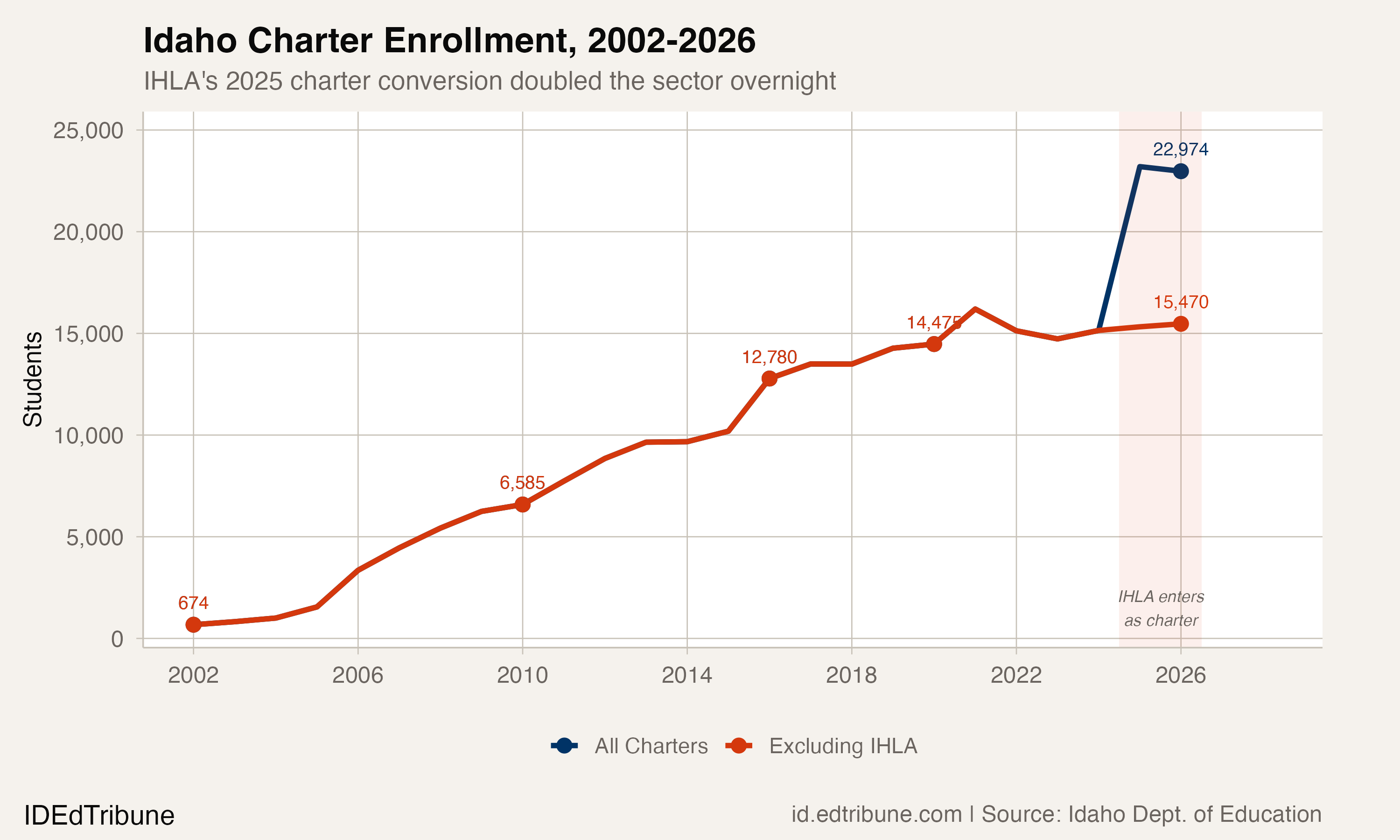
Idaho's charter trajectory tells a clean three-act story. From 2002 to 2010, the sector grew from five schools to 20, adding 5,911 students in its startup era. From 2010 to 2020, another 12 charters opened and enrollment doubled to 14,475, a maturation phase averaging about 790 students per year in growth. Then came the IHLA conversion.
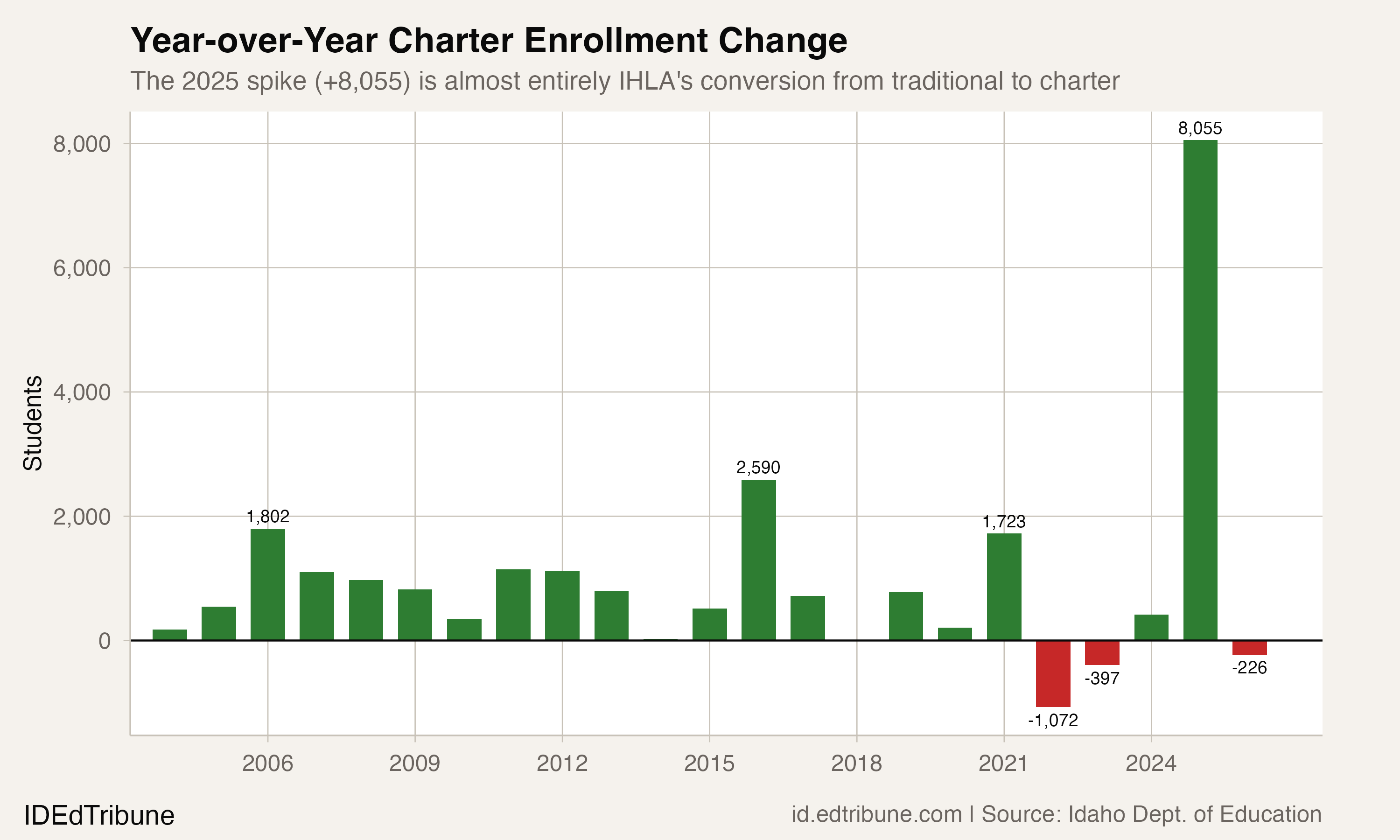
In 2025, charter enrollment jumped from 15,145 to 23,200, a single-year gain of 8,055 students. Almost all of it was bookkeeping. IHLA's 7,876 students had already been enrolled in public school through Oneida County. They did not change classrooms, curriculum, or zip codes. What changed was the line item.
The Oneida County School District, which had reported 8,805 students in 2023-24, dropped to 956 overnight.
Brick-and-mortar charters hit a ceiling
The more consequential finding is what happened to the physical charter schools. Excluding IHLA and Inspire Virtual Charter, brick-and-mortar charter enrollment was 12,940 in 2019-20. In 2025-26, it was 13,917, a gain of 977 students over six years, or 7.6%. That is 977 students spread across 30 schools over six years, an average gain of about five students per school per year.
The charter count peaked at 34 in 2020-21 and has since fallen to 32. Two charters, Rolling Hills Public Charter and Bingham Academy Charter, disappeared between 2023-24 and 2025-26. No net new brick-and-mortar charters have opened since 2021.
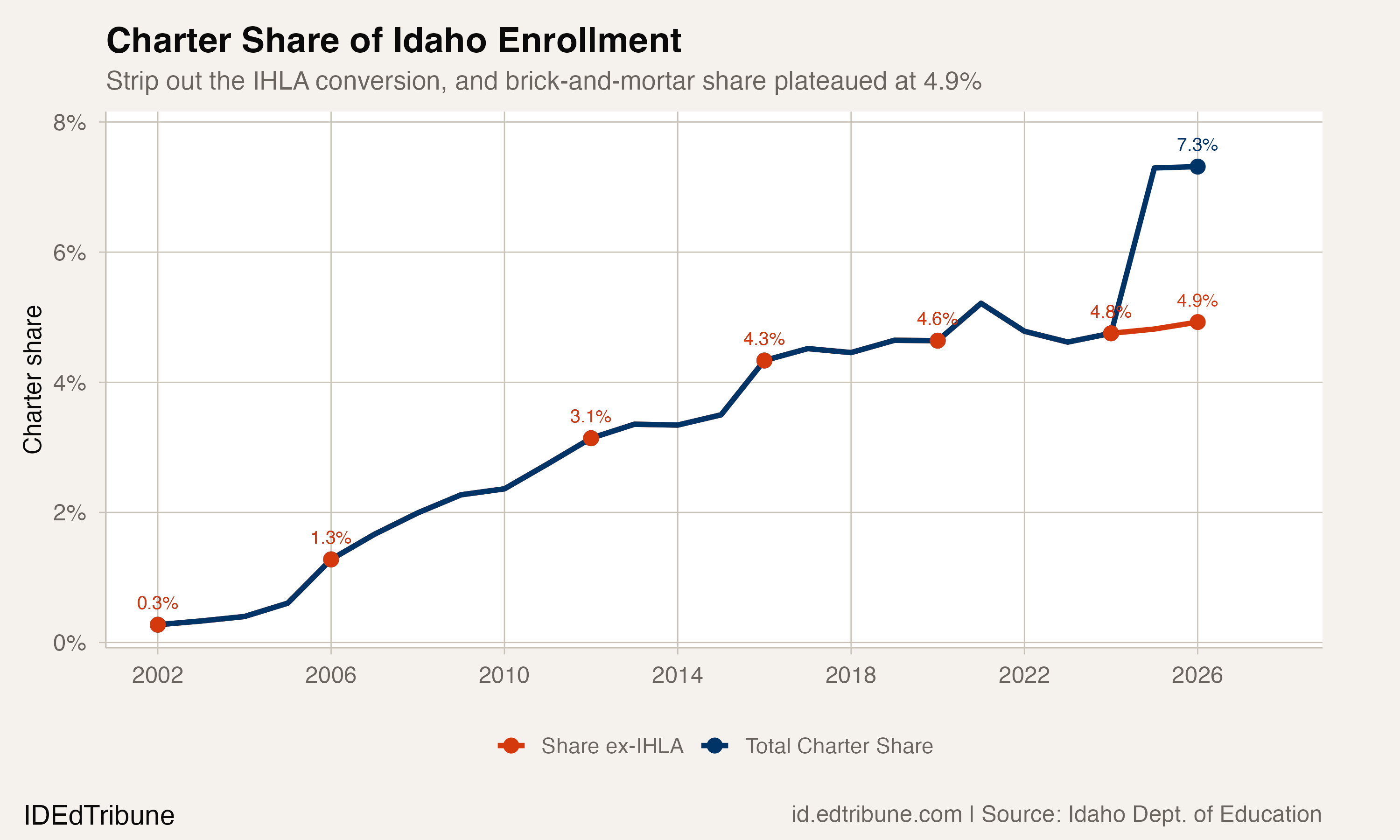
The market share chart makes the plateau visible. Excluding IHLA, charter share in 2025-26 is 4.9%, up just 0.1 percentage points from 2023-24. The apparent jump from 4.8% to 7.3% is entirely the IHLA reclassification.
IHLA: the largest school nobody audited
IHLA is not a typical charter. Authorized by the Oneida County School District rather than the Idaho Public Charter School Commission, it operates as a virtual K-12 program enrolling students from 70% of Idaho's zip codes. At 7,504 students, it is larger than all but nine traditional districts in the state.
A December 2025 report from the Idaho Office of Performance Evaluations found that the school's rapid growth outpaced its oversight. IHLA's three private service providers spent $12.6 million on supplemental learning funds for families in 2024-25, but the report found no standardized guidelines for how that money was spent. Unspent funds were retained by the vendors rather than returned to the state.
"I strongly encourage the Legislature to address the loopholes in state statute." -- Governor Brad Little, responding to the OPE report
IHLA receives $6,150 per student, below the state average of roughly $8,400. The lower per-pupil cost is characteristic of virtual schools, which carry no facility expenses. Whether that translates to comparable outcomes is an open question. The OPE report noted "marginal test scores" without providing statewide comparisons in its published findings.
Virtual schools now dominate the charter sector
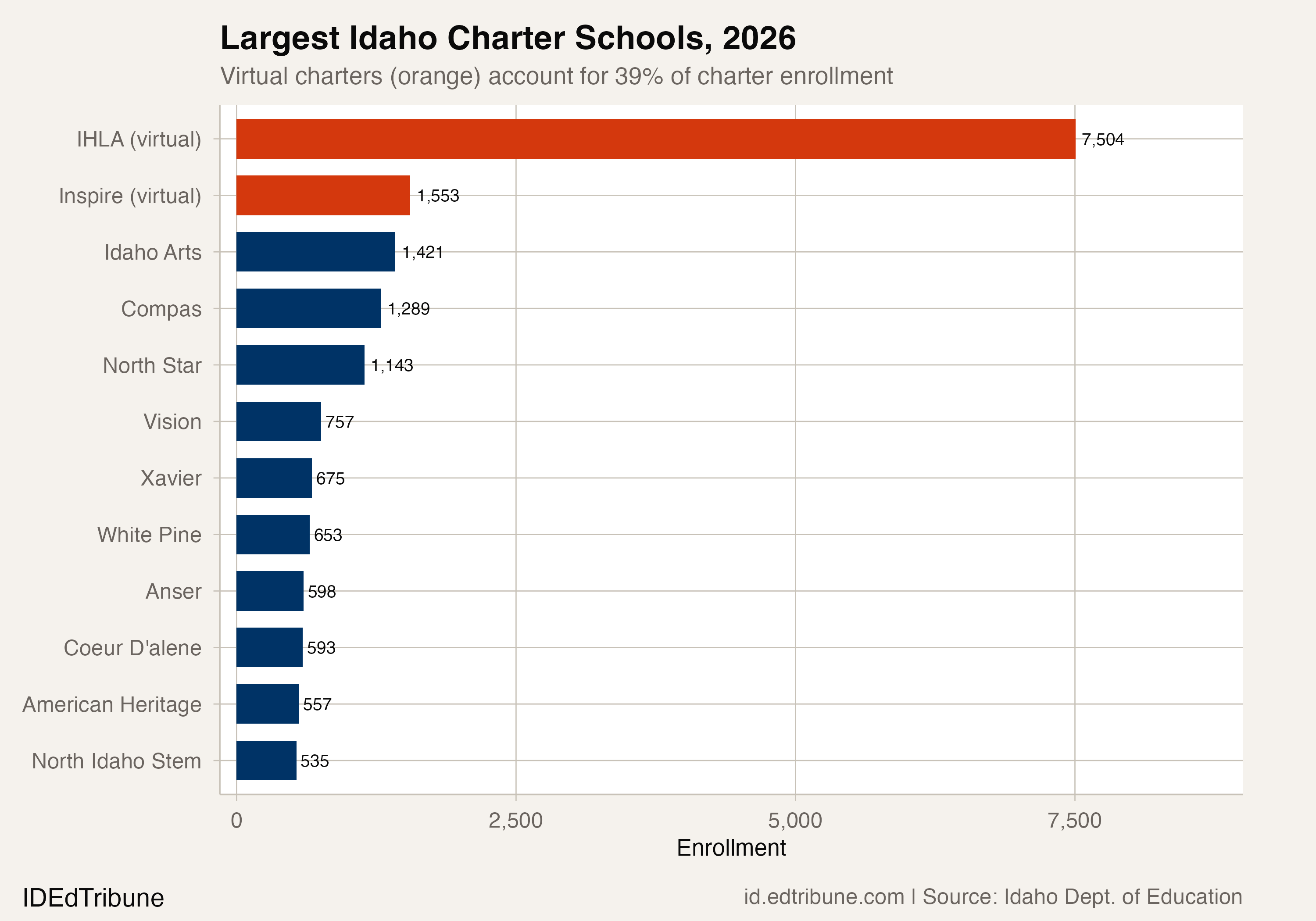
IHLA and Inspire Virtual Charter together enroll 9,057 students, 39.4% of Idaho's charter sector. The next largest charter, Idaho Arts Charter, enrolls 1,421. No brick-and-mortar charter exceeds 1,300 students.
This concentration is new. Before 2025, virtual charters accounted for about 9-11% of charter enrollment. The IHLA conversion quadrupled that share in one year. Idaho's charter sector is now functionally two sectors: a constellation of small physical schools averaging around 450 students each, and two virtual programs that together are larger than the other 30 charters combined.
The competitive landscape is shifting
The charter sector's internal dynamics matter less to traditional districts than the broader competitive pressure they face. Idaho's total public enrollment peaked at 318,979 in 2022-23 and has since fallen to 314,097, a decline of 4,882 students in three years.
State Superintendent Debbie Critchfield has framed this as a choice story rather than a loss story.
"In large part, families are still choosing public education, but they're choosing it in different forms." -- Idaho EdNews, October 2025
But the competitive pressure is about to intensify from outside the public system. Governor Little signed HB 93 in February 2025, creating a $5,000-per-student refundable tax credit for private school families, capped at $50 million statewide. The Idaho Supreme Court unanimously upheld the program on February 5, 2026. Applications opened January 15, 2026.
Meanwhile, Bluum, the nonprofit that administers federal Charter Schools Program grants in Idaho, holds $24.8 million in federal funding to create 5,900 new charter seats by 2028. Gem Prep, the state's largest charter network, broke ground on its eighth campus in Idaho Falls in September 2025, with a Rexburg location planned for 2027.
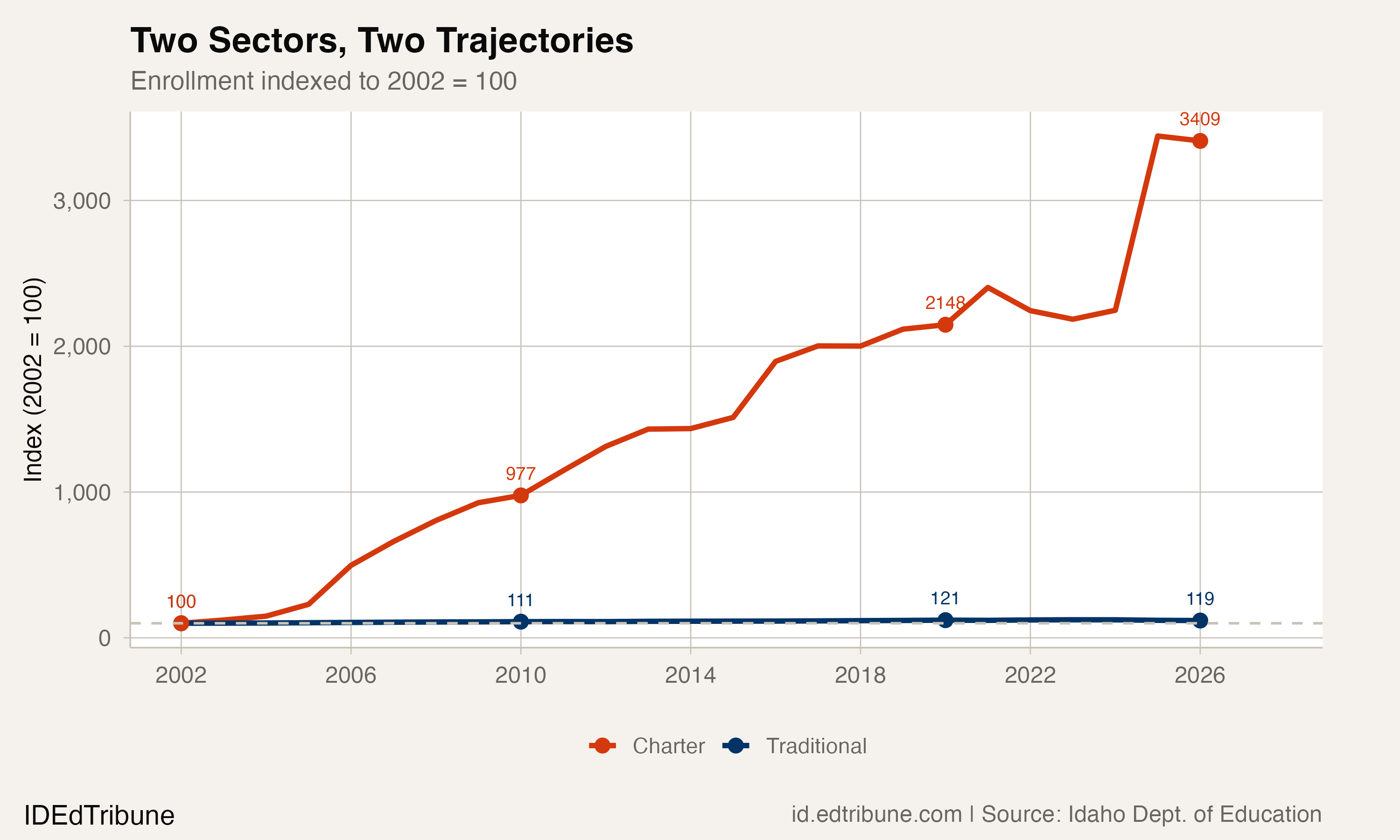
Two sectors under one label
Strip out the bookkeeping, and Idaho's charter story splits in two. The virtual side, dominated by IHLA and Inspire, accounts for 39.4% of charter enrollment and faces mounting legislative scrutiny over spending controls. The brick-and-mortar side, 30 schools averaging about 450 students each, has not added a net new school since 2021 and grew just 977 students in six years.
Meanwhile, over 10,700 students sit on charter waiting lists. Bluum holds $24.8 million in federal funding to create 5,900 new seats by 2028. And a $50 million private school tax credit, upheld by the Idaho Supreme Court, has started accepting applications. Idaho's 34-fold charter expansion over 24 years is a real growth story. But the next chapter will be written by three different forces -- virtual accountability, brick-and-mortar capacity, and private-school competition -- pulling in three different directions.
Detailed code that reproduces the analysis and figures in this article is available exclusively to EdTribune subscribers.
Discussion
Sign in to join the discussion.
Loading comments...