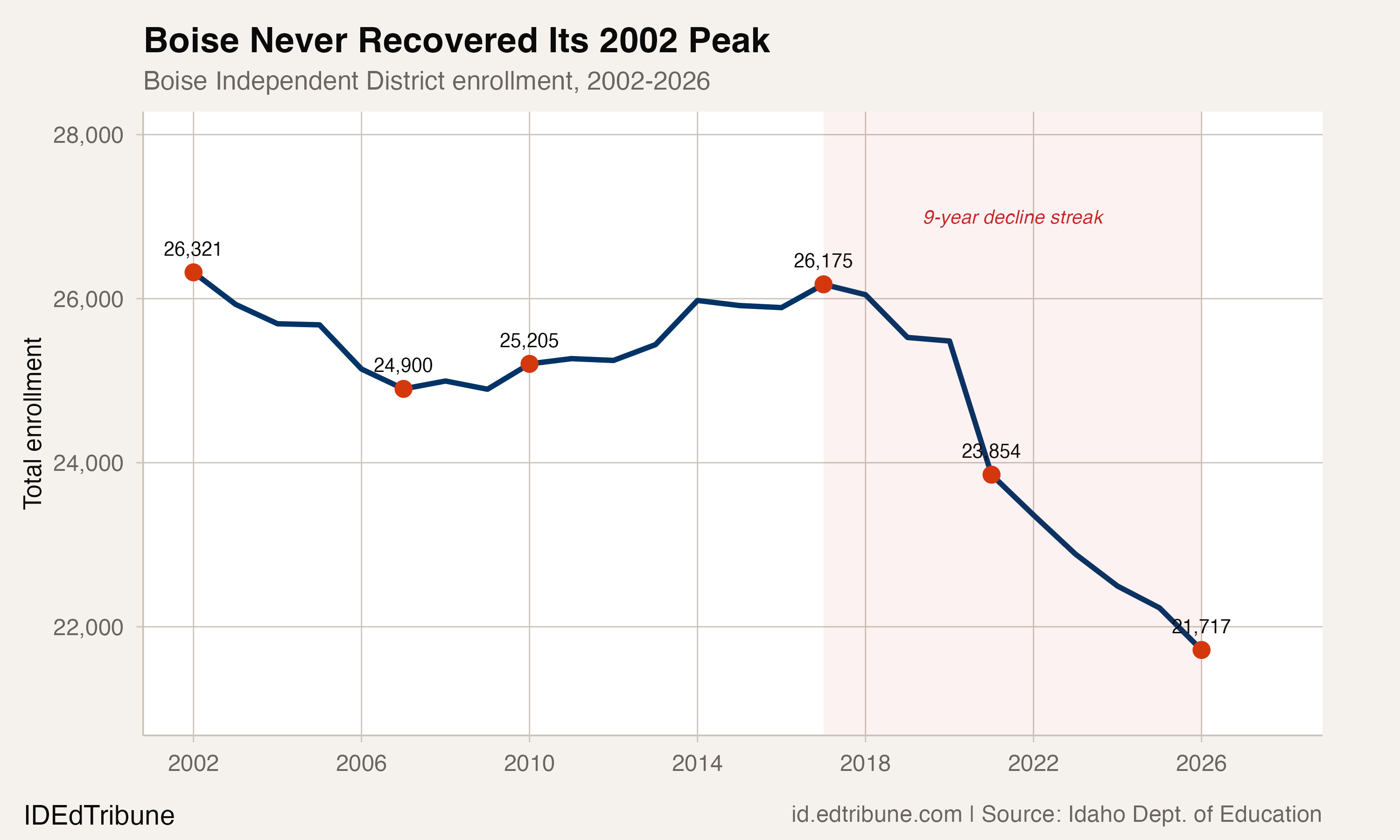
In 2002, Boise Independent District↗ET was Idaho's largest school system. It enrolled 26,321 students, 1,260 more than its suburban neighbor to the west. Twenty-four years later, Boise enrolls 21,717, a loss of 4,604 students, 17.5% of its peak enrollment. West Ada District↗ET, that former runner-up, now serves 37,919 students and leads by 16,202.
The numbers would be bad enough if Boise were shrinking alongside the state. It is not. Idaho added 15,332 students statewide between 2017 and 2026, a 5.1% gain. Boise shed 4,458 during the same window. The district has posted a loss every single year since 2018, nine consecutive years of decline with no year of reprieve.
A district that peaked twice and still couldn't hold
Boise's enrollment history reads as two declines separated by a false recovery. From 2002 to 2007, the district dropped from 26,321 to 24,900, losing 1,421 students as early suburban growth pulled families into Meridian and Eagle. A decade-long recovery followed, clawing back 1,275 students by 2017 to reach 26,175, still 146 below the 2002 mark.
Then the second decline began, and it has been far steeper.
The pre-COVID losses were modest: 127 students in 2018, 521 in 2019, 43 in 2020. The pandemic year of 2021 was catastrophic, erasing 1,630 students in a single year, a 6.4% drop. But the five years since have been collectively worse. From 2022 through 2026, Boise lost another 2,137 students, an average of 427 per year, nearly double the pre-COVID pace of 230 per year.
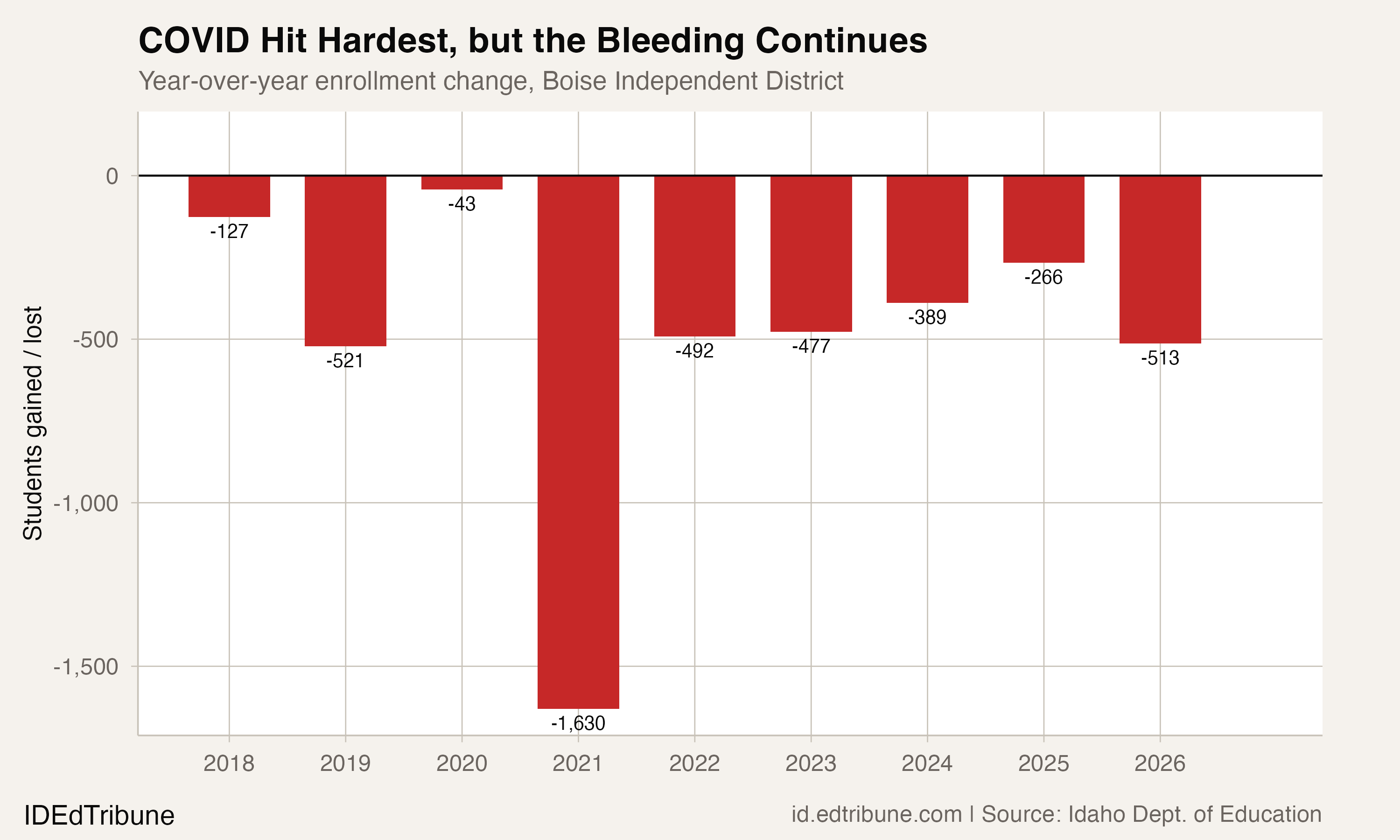
The 2026 loss of 513 students, 2.3% of enrollment, was the second-largest year-over-year drop outside the pandemic. The district is not stabilizing. It is losing ground faster than it did before COVID.
Where the students aren't
The grade-level data makes the pipeline problem visible. Since 2017, kindergarten enrollment in Boise has fallen from 1,700 to 1,269, a 25.4% decline. First grade is down 27.1%. Second grade is down 27.7%. The losses weaken steadily by grade: 23.1% in third, 17.4% in fifth, 13.1% in ninth, and just 1.4% in twelfth.
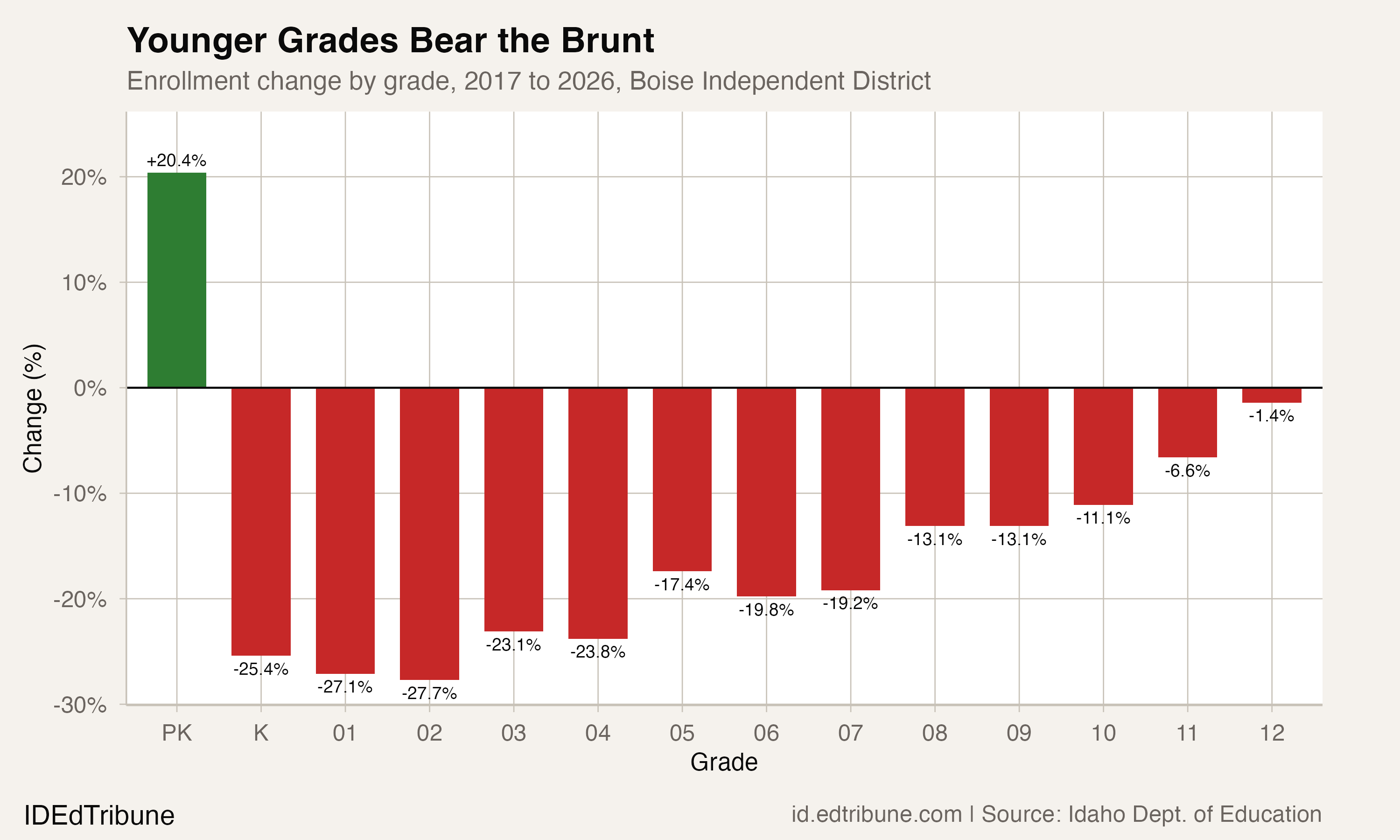
Pre-kindergarten is the sole growth spot, up 20.4%, though from a small base of 318 to 383. The district has expanded early childhood programs and full-day kindergarten to attract families earlier. The pipeline data suggests this will not offset the structural decline: the kindergarten classes entering now are 25% smaller than those a decade ago.
The suburban inversion
In 2002, Boise enrolled 1,260 more students than West Ada. By 2003, West Ada had already passed it. The gap has widened every decade since.
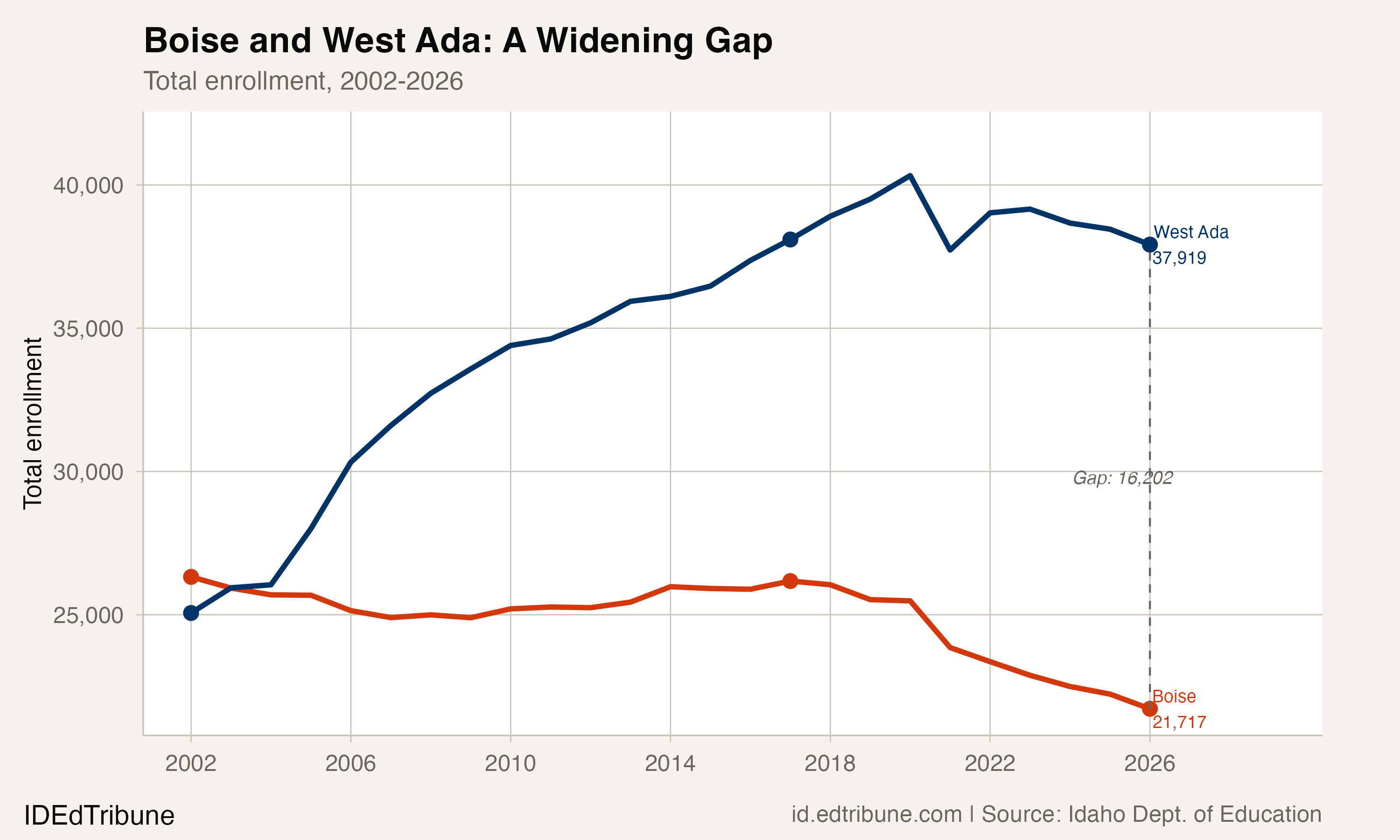
West Ada's growth has stalled in recent years, falling from a peak of 40,326 in 2020 to 37,919 in 2026. But the comparison with Boise is instructive: West Ada lost 2,407 students from its peak and remains 12,858 above its 2002 level. Boise lost 4,604 from its peak and sits 4,604 below where it started.
The pattern extends beyond West Ada. Vallivue School District↗ET, serving the fast-growing Caldwell-area suburbs in Canyon County, grew 26.7% from 2017 to 2026, adding 2,254 students to reach 10,700. Bonneville Joint District↗ET in eastern Idaho grew 10.5%. Meanwhile, Nampa School District↗ET, an older urban core like Boise, lost 13.0%, and Boise's 17.0% loss is the steepest among Idaho's large districts.
A shrinking share of a growing state
Idaho's total K-12 enrollment grew 27.6% from 2002 to 2026, from 246,184 to 314,097. Boise's share of that total fell from 10.69% to 6.91%.
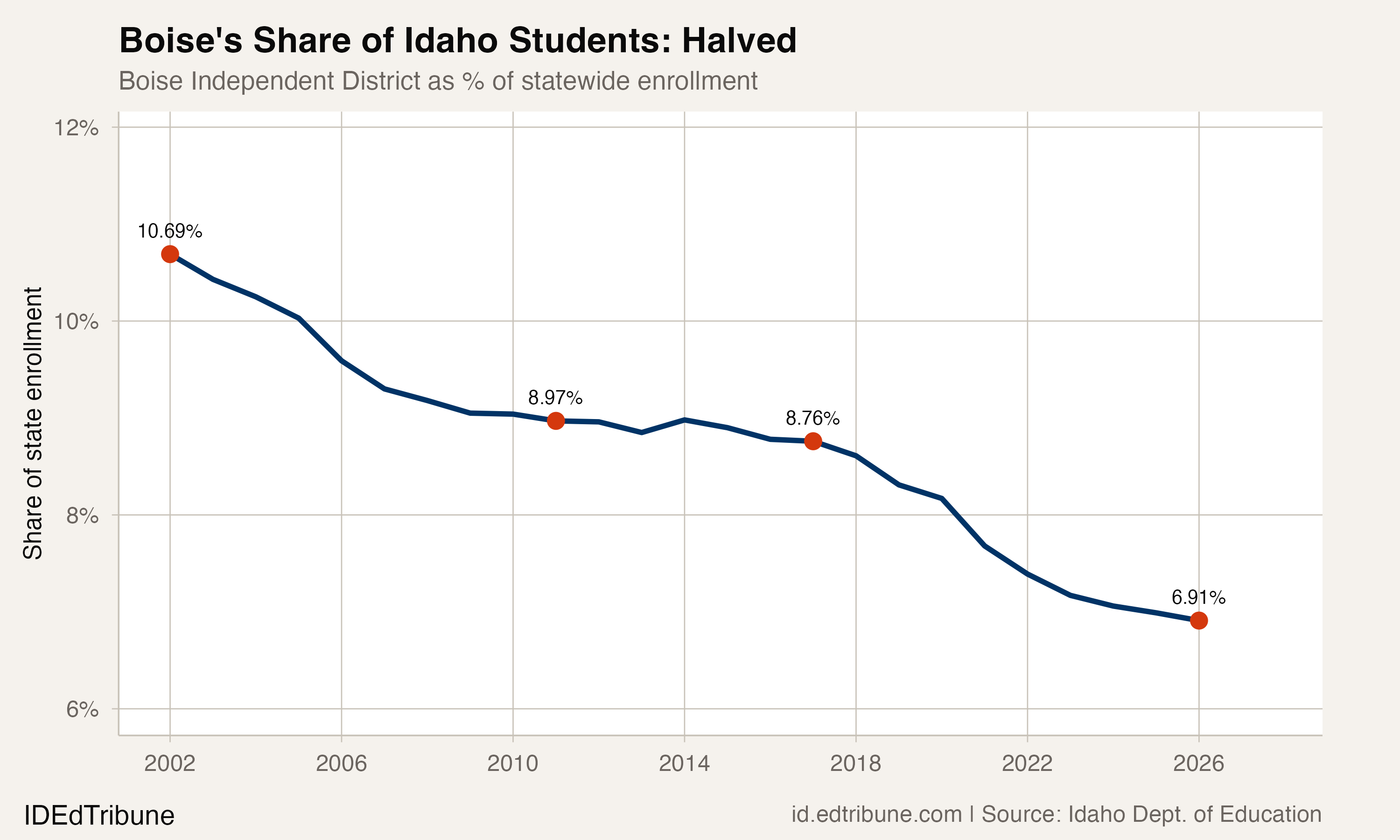
The shrinkage is relentless. Boise's share has fallen in 22 of the last 24 years. It dropped below 9% in 2011, below 8% in 2020, and below 7% in 2025. A district that once enrolled more than one in 10 Idaho students now enrolls fewer than one in 14.
Housing, births, and retirees
Three forces converge on Boise's enrollment.
The most direct is housing costs. Boise's median home price reached approximately $480,000 by early 2025, pricing out many young families. The district itself has acknowledged that gentrification and rising home prices are pushing families into more affordable areas in Canyon County and beyond.
"We're seeing this in places like Denver and Salt Lake City -- these Western cities where there's a bunch of growth, but it's not in the typical boundaries of the big city. It's in the suburbs." -- Terry Ryan, Bluum CEO, Idaho EdNews, June 2023
The second force is demographic. Idaho's birth rate fell 29% between 2007 and 2021, from 16.6 to 11.8 births per 1,000 population. Smaller birth cohorts are now flowing through the K-12 pipeline. Boise's kindergarten class has shrunk from 1,931 in 2014 to 1,269 in 2026, a 34.3% decline that tracks closely with the birth-rate curve lagged by five years.
The third force is the composition of Idaho's population boom. Despite being one of the fastest-growing states in the nation, 90% of Idaho's population growth from 2019 to 2022 came from adults over 18. The new residents are disproportionately retirees without school-age children, which means population growth and enrollment growth have decoupled.
"The main source of population growth in Idaho is going to be new residents moving into the state." -- Boise State Public Radio, July 2025
For Boise specifically, the alternatives include both suburban traditional districts and a charter sector that grew from 4.5% of statewide enrollment in 2017 to 7.3% in 2026. How much of Boise's loss flows to charters versus suburban migration is not captured in the enrollment data.
Budget math and 27 fewer positions
In Idaho, per-pupil funding follows students. Every student who leaves takes state dollars with them. The district cut 27 full-time positions in 2023, nine elementary teachers, 17 secondary teachers, and one assistant principal, to align staffing with declining headcount. The district's average daily attendance fell to its lowest level since 1983-1984.
The fiscal pressure is not unique to Boise. Eight of Idaho's 10 largest school districts lost enrollment in 2025-2026. But Boise's losses are the largest in absolute terms and the steepest in percentage terms among major districts, meaning its budget adjustments must be proportionally deeper.
Approaching 20,000
Boise enrolled 1,945 twelfth-graders in 2026 and 1,269 kindergartners. Each year, roughly 700 more students graduate out than enter at the bottom. At the current pace, the district will fall below 20,000 students within three years.
Twenty-seven positions are already gone. Average daily attendance has not been this low since Ronald Reagan's first term. The district that defined Idaho public education for decades now manages a building portfolio designed for 26,000 students with fewer than 22,000 inside them.
Detailed code that reproduces the analysis and figures in this article is available exclusively to EdTribune subscribers.
Discussion
Sign in to join the discussion.
Loading comments...